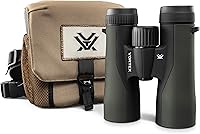
How Far Can You See With 10x42 Binoculars?
How far you can see with 10x42 binoculars has no fixed distance limit. Large landmarks can be visible miles away, but identifying small wildlife needs clearer air, enough light, and a steady view.
On this page (8 sections)
- How far can you see with 10x42 binoculars?
- What limits how far you can see?
- Does 10x magnification mean the view is 10 times better?
- Which 10x42 binoculars fit this kind of viewing?
- How should you set up binoculars for distant detail?
- How can you get a clearer view at long distance?
- Which mistakes reduce useful viewing distance?
- How should you decide whether 10x42 gives enough reach?
How far can you see with 10x42 binoculars? Large landmarks can be visible miles away, but there's no fixed maximum distance or guaranteed range for identifying wildlife.
The useful question is what detail you need: spotting an animal, recognizing its shape, and seeing small markings are different tasks. Buying another 10x42 pair won't bring the subject closer through extra magnification, so choose for fit, support, and your surroundings.
How far can you see with 10x42 binoculars?
10x42 binoculars enlarge the apparent size of distant subjects 10 times, provided those subjects are visible and within focus range. They don't have a distance cutoff like a flashlight beam.
A mountain several miles away can fill part of the view, while a small bird at a much shorter distance may remain hard to identify. Size and contrast explain much of that difference.
What does 10x42 viewing distance look like in practice?
A subject at 1,000 yards appears roughly the size it would at 100 yards without magnification. This describes apparent size, not the clarity you'd get by physically moving closer.
| Your goal | What to expect |
|---|---|
| Spot a distant building or mountain | Large shapes may be visible miles away in clear conditions. |
| Locate wildlife across open ground | Movement or an outline may be visible before identifying features are clear. |
| Identify a bird or animal | You need enough detail to separate it from similar species. |
| Read distant signs or small markings | Letter size, contrast, focus, and air quality become critical. |
Don't buy around a claimed maximum range. For more on what the size means, read what the numbers on binoculars mean.
What limits how far you can see?
Clear air and an open sightline set the starting point. Magnification can't reveal an animal behind a ridge or recover detail lost in thick haze.
- Terrain and the horizon: Hills, trees, buildings, and Earth's curve can block subjects. A higher viewpoint may open the sightline.
- Haze, smoke, and mist: These reduce contrast, making distant outlines blend into the background.
- Heat shimmer: Rising warm air can make edges ripple, especially across sunlit roads, sand, or fields.
- Light direction: A backlit animal may appear as a silhouette, hiding the colors you need for identification.
- Movement: Shaking hands, wind, and a moving boat make small details harder to follow.
NOAA's explanation of visibility describes how particles in the air affect what you can see.
If the whole scene looks washed out, changing focus won't clear the air. Try a different angle, wait for better conditions, or move closer where access allows.
Does 10x magnification mean the view is 10 times better?
No, a larger image doesn't guarantee more readable detail. Correct focus, suitable optics, and a steady hold determine how much that enlargement helps.
Ten-power binoculars also enlarge the motion from your hands. If you keep chasing a bouncing image, lower power may give you a more useful view.
For dawn or dusk, the 42 mm front lenses are only part of the picture. Coatings, subject contrast, and your eyes also affect what you can make out.
Read 8x42 vs. 10x42 binoculars if you're deciding between distant detail and an easier handheld view.
Which 10x42 binoculars fit this kind of viewing?
Choose around how you'll find, carry, and steady the binoculars. All 4 pairs use the same nominal magnification, so none gains extra reach simply by being a different model.
Vortex Triumph HD 10x42
Choose the Triumph for outdoor walks and hikes where you want binoculars close at hand. The included carrying setup makes sense if you'll stop often to scan rather than keep the pair inside a backpack.
It has fully multi-coated lenses, waterproof and fogproof construction, and tripod adaptability. Its 17 mm eye relief is worth considering if glasses limit how close your eyes can sit to the eyepieces.
Skip this choice if you want to carry as little gear as possible and won't use a chest harness. Vortex backs it with a transferable lifetime VIP warranty, excluding loss, theft, deliberate damage, and cosmetic damage that doesn't affect performance.
Vortex Crossfire HD 10x42
Choose the Crossfire for watching from a fixed position, such as a sheltered overlook or a parked vehicle. Support compatibility matters when you want to study a distant subject rather than take a quick look.
Its rubber armor provides grip, while nitrogen purging and O-ring seals protect against water intrusion and internal fogging. The center wheel handles focus, with a right-eyepiece diopter for differences between your eyes.
Skip it if you need more room between your glasses and the eyepieces: its 15 mm eye relief is the shortest here. A compatible mount is a separate part of your setup, so account for carrying and positioning it.
Nikon PROSTAFF P3 10x42
Choose the Nikon for searching open ground and locating moving wildlife. Its field of view covers 367 feet at 1,000 yards, giving you room around a subject while you track it.
Multilayer-coated lenses and a silver-alloy prism coating support light transmission. The fiberglass-reinforced polycarbonate body has rubber armor, and the pair weighs 1.3 pounds.
Skip this pair if you're counting on its eye relief measurement alone to guarantee a full view through glasses. Face shape and frame position matter, so check whether you can see the whole circular image without pressing the eyepieces against your lenses.
Bushnell H2O Xtreme 10x42
Choose the Bushnell for boating, fishing, and wet outings where accidental immersion is a concern. Its weather protection and soft non-slip grips address a different need from gaining more magnification.
It combines fully multi-coated glass surfaces with BaK-4 prisms and includes a strap, case, and lens covers. The 17 mm eye relief provides another option for glasses wearers, subject to individual fit.
Skip it if neck weight is your main concern on long walks. At 709 g, it's the heaviest pair here, so decide how you'll carry it before choosing it for an all-day hike.
How should you set up binoculars for distant detail?
Set the barrel spacing, eyecups, and diopter before judging sharpness. A poor fit can cause dark edges, eye strain, or a view that never seems clear in both eyes.
- Adjust the hinge. Move the barrels until the 2 images form 1 circle.
- Set the eyecups. Start lowered with glasses and raised without them, then adjust for a full view without dark crescents.
- Set the diopter. Follow the model's instructions to focus each eye correctly on the same stationary target.
- Use the center focus afterward. Refocus when you switch between nearby and distant subjects.
Our guide to how to focus binoculars explains the adjustment sequence. For fit problems with glasses, read about binocular eye relief.
How can you get a clearer view at long distance?
Reduce movement before reaching for more magnification. Rest your elbows on a stable surface, sit down, or use a compatible support for longer viewing.
Keep your elbows closer to your body and avoid gripping so hard that your arms tense. On a boat, expect the platform's movement to remain part of the view even with careful technique.
Find the subject with your eyes first, then raise the binoculars while keeping your gaze fixed on it. This is usually quicker than searching through the binoculars from the start.
For wildlife, scan in small overlapping sections and pause at promising shapes. See what size binoculars you need for bird watching if finding moving birds matters more than inspecting stationary subjects.
Which mistakes reduce useful viewing distance?
Poor support, dirty lenses, and unrealistic detail goals waste the most useful magnification. Fix those before assuming you need a different pair.
Don't view through a window if you can safely step outside. Glass, reflections, and temperature differences can soften an otherwise clear view.
Don't keep turning the diopter to chase atmospheric shimmer. Once it's set for your eyes, use the center wheel for distance changes.
Keep lenses covered during transport and remove loose grit before wiping. Follow how to clean binoculars to avoid dragging dirt across the coatings.
Dry wet binoculars before storing them in a closed case. Waterproof construction doesn't keep fingerprints, dried droplets, or condensation off the outside surfaces.
How should you decide whether 10x42 gives enough reach?
How far you can see with 10x42 binoculars matters less than whether you can resolve the detail your activity needs. Choose this size for portable distant viewing when you can hold the image steadily.
Pick the Triumph for its included harness, the Crossfire for supported viewing, the Nikon for searching a broad scene, or the Bushnell for wet outings. Let fit and carrying comfort settle the choice between pairs with the same power.
If your goal is fine detail on small subjects far across open country, consider supported higher magnification. Our binoculars vs. spotting scope guide explains that next step.
If shake or finding nearby wildlife is the bigger problem, compare 8x42 vs. 10x42 binoculars before buying.
Frequently asked questions
How far can you see with 10x42 binoculars?
There is no fixed maximum distance for 10x42 binoculars. You can see large landmarks miles away when the air and sightline are clear, but small subjects need to be much closer for useful detail.
Subject size, contrast, light, and a steady hold matter more than a claimed viewing range.
Can 10x42 binoculars see 1,000 yards?
Yes, you can view visible subjects 1,000 yards away, but identifying them depends on their size and the conditions. At 10x, their apparent size is roughly what you would see unaided from 100 yards.
That comparison describes size only; haze, heat shimmer, and hand shake can still hide detail.
Are 10x42 binoculars good for long-distance viewing?
Yes, 10x42 binoculars suit distant wildlife and landscape viewing when you can hold them steadily. They balance magnification with a size you can carry outdoors, but they won't replace a spotting scope for every task.
Choose more powerful supported optics if you need fine detail on small, faraway subjects.
What does 42 mean in 10x42 binoculars?
The 42 means each front objective lens measures 42 mm across, while 10x describes the magnification. Dividing 42 by 10 gives a 4.2 mm exit pupil, the light circle leaving each eyepiece.
Read what the numbers on binoculars mean to understand how these figures affect your choice.