What Size Binoculars Do You Need for Bird Watching?
8x42 is the best starting size for most people choosing binoculars for bird watching. Choose 8x32 for lighter daytime carry or 10x42 for distant birds if you can hold the view steady.
On this page (7 sections)
- What size binoculars are best for bird watching?
- Does more magnification make birds easier to identify?
- Do larger lenses help at dawn or dusk?
- Which 8x42 binoculars suit different bird watchers?
- How do you check fit and set up binoculars?
- Which mistakes should you avoid when choosing and using binoculars?
- What size binoculars should you choose for bird watching?
8x42 is the best starting size for most people deciding what size binoculars for bird watching to buy. It balances a steady handheld view, useful light gathering, and enough magnification for many birds in parks, woods, and gardens.
Choose a smaller pair if carrying weight is your main concern. Move to higher magnification when distant birds are your usual subjects and you can keep the view steady.
The first number is magnification; the second is the diameter of each front lens in millimeters. See what the numbers on binoculars mean for help reading those labels.
What size binoculars are best for bird watching?
Choose 8x42 for mixed birding, 8x32 for lighter daytime carry, or 10x42 for distant birds. Smaller compact binoculars suit occasional viewing when pocket space matters more than performance in dim light.
| Size | Best fit | Main tradeoff |
|---|---|---|
| 8x25 | Travel and short daytime outings | Less forgiving eye placement and smaller objectives |
| 8x32 | Long walks in good daylight | Less light gathering than a comparable 8x42 |
| 8x42 | Woodland, gardens, and general birding | More bulk than smaller options |
| 10x42 | Open fields, lakes, and shorelines | More visible shake, often a narrower view |
| 8x50 or 10x50 | Mostly stationary viewing in dim light | Larger lenses usually add weight and bulk |
These are size guidelines, not promises about optical quality. Coatings, fit, focus, and construction still matter within each size.
What size bird watching binoculars should beginners choose?
Start with 8x42 unless you have a clear reason to carry something smaller. Lower magnification makes it easier to aim at a bird and keep it in view while adjusting focus.
For mixed woodland and open-country outings, choose based on the birds you watch most often. Our 8x42 vs 10x42 binoculars guide explains when extra reach earns its place.
Does more magnification make birds easier to identify?
More magnification helps only when the view stays steady enough to show detail. A larger but shaking image can make fine markings harder to read.
An 8x view is useful for following small birds between branches. A comparable 10x model often shows less of the surrounding scene, so finding the bird takes more precise aim.
Choose higher power for birds that sit at a distance, such as waterbirds across a lake. Brace your elbows against your body or a firm support before deciding you need still more magnification.
Field of view varies by model, so compare that figure separately. Don't assume every pair with the same magnification shows the same width of scenery.
Do larger lenses help at dawn or dusk?
Larger objectives can help in dim light, but they usually increase carrying bulk. For many bird watchers, 42 mm lenses are a practical middle ground between small daytime binoculars and larger pairs.
Exit pupil helps explain the difference: divide objective diameter by magnification. An 8x42 produces a 5.25 mm exit pupil, while a 10x42 produces 4.2 mm.
That larger light circle can make eye placement more forgiving and help in dim conditions when your pupils widen. It doesn't guarantee a brighter view across different models because optical quality also matters.
In bright daylight, smaller binoculars can be enough. Don't carry large objectives solely for brightness if most of your outings happen in open parks around midday.
Which 8x42 binoculars suit different bird watchers?
Choose among these pairs by carrying comfort, glasses fit, and viewing habits. All 4 share the same size label, but they offer different reasons to buy.
Celestron Nature DX: for nearby birds and woodland walks
The Celestron Nature DX 8x42 suits birders who alternate between nearby subjects and wider scanning. Its 6.5 ft close focus is useful around feeders, while its 7.4° angular field of view helps you search branches.
Fully multi-coated lenses and phase-coated BaK-4 prisms are reasons to consider it for regular birding. Waterproof construction and nitrogen purging also suit outings in changing weather.
Choose it when nearby viewing matters more than trimming carrying weight. At 1.8 lb, it's a pair to skip if neck fatigue is already a concern.
For other choices beyond these examples, see our best binoculars for bird watching.
Nikon PROSTAFF P3: for glasses wearers and longer walks
The Nikon PROSTAFF P3 8x42 is the strongest fit here for buyers prioritizing low weight and generous eye relief. It weighs 1.3 lb and has turn-and-slide eyecups.
Its multilayer-coated lenses and silver-alloy prism coating support light transmission. The field of view is 377 ft at 1,000 yards, giving you a useful figure to compare against other models.
Choose it if you keep your glasses on while birding or want the lightest pair among these 4. Skip it if you need a pocket-size binocular, since lower weight doesn't make a full-size body pocketable.
Glasses shape and lens thickness affect fit, so eye relief isn't a guarantee of seeing the entire image. Our guide to binoculars for glasses wearers explains what to check.
Vortex Crossfire HD: for walkers who want a harness
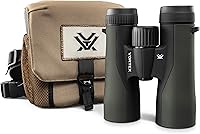
The Vortex Crossfire HD 8x42 suits birders who want an included carrying harness. Its GlassPak harness gives you an alternative to leaving the binoculars hanging from a neck strap.
It weighs 1.5 lb and has fully multi-coated lenses, waterproof seals, and nitrogen purging. Tripod adaptability is useful for watching one area for longer periods.
Choose it when the carrying system is part of your buying decision. Glasses wearers should be more cautious: its 14 mm eye relief offers less room than the Nikon above.
For a wider view of sizes and uses, see our binoculars guide.
Celestron Outland X: for casual outdoor viewing
The Celestron Outland X 8x42 suits casual bird watchers who want weather protection and adjustable eyecups. It combines multi-coated lenses, BaK-4 prisms, and a rubber-armored polycarbonate body.
Its 17.8 mm eye relief provides another option to consider for glasses use. Tripod adapter threads allow supported viewing, though the adapter is separate.
Choose it for park visits and feeder watching when carrying weight is a secondary concern. At 1.8 lb, it isn't the choice here for reducing the load on long walks.
Waterproofing and nitrogen purging serve different purposes. Read whether waterproof and fogproof binoculars are worth it if damp weather is common where you bird.
How do you check fit and set up binoculars?
Adjust the binoculars to your eyes before judging sharpness or comfort. Poor barrel spacing or eyecup position can cause dark edges even when the size is right.
- Adjust the hinge until both views merge into one round image.
- Start with eyecups down if you wear glasses, or raised without glasses, then adjust for a full view.
- On models with a diopter, follow the instructions to balance focus between your eyes.
- Use the main focus control as the bird's distance changes.
Follow how to focus binoculars the right way for the full setup. If you struggle to see the edges with glasses on, learn how binocular eye relief affects the usable view.
Practice aiming at a fixed object before following birds. Keep looking at the bird as you raise the binoculars to your eyes, rather than looking down at the barrels first.
Which mistakes should you avoid when choosing and using binoculars?
Avoid choosing by magnification alone or confusing smaller lenses with poor quality. The right size is one you can carry, aim, and focus comfortably.
Don't expect binoculars to make a partly hidden bird visible through leaves. Move for a clearer angle instead of reaching for more power.
Don't judge carrying comfort from a brief look through the eyepieces. Consider the weight during a full walk and whether you prefer a strap or harness.
Keep caps on during transport and remove loose grit before wiping lenses. Use our binocular cleaning guide to avoid dragging dirt across the glass.
Let wet binoculars dry before closing them in a case. Weather sealing protects internal parts, but it doesn't remove water or dirt from the outer lenses.
What size binoculars should you choose for bird watching?
Choose 8x42 for regular bird watching in mixed settings, then narrow the choice by fit. Among these examples, favor the Nature DX for nearby subjects, the Nikon for weight and glasses clearance, the Crossfire HD for its harness, or the Outland X for casual outdoor use.
Choose 8x32 if carrying bulk would otherwise leave your binoculars at home. Choose 10x42 when distant birds dominate your outings and you can hold higher power steady.
Before ordering, use how to choose binoculars for bird watching to check the remaining details, especially eye relief, field of view, and carrying comfort.
Frequently asked questions
Are 10x42 binoculars good for bird watching?
Yes, 10x42 binoculars suit distant birds across fields, lakes, and shorelines. The extra magnification also enlarges hand movement, so they work best when you can keep your arms steady or brace against a support.
Compare field of view too, especially if you often follow birds in flight.
Is 8x42 or 10x42 better for bird watching?
Choose 8x42 for woodland walks, moving birds, and easier handheld viewing. Choose 10x42 when distant birds fill most of your outings and you can manage the extra shake.
Both have the same objective lens diameter, but the steadier view from an 8x pair can make identifying details easier.
What do the numbers 8x42 mean?
An 8x42 binocular has 8x magnification and front lenses measuring 42 mm across. The magnification makes a bird appear about eight times closer than it does with your bare eyes.
The lens diameter affects light gathering and bulk, but it doesn't tell you the binocular's total width or weight.
Are 8x42 binoculars too big for bird watching?
No, 8x42 is a useful full-size choice for regular bird watching, especially in woodland shade or fading daylight. Carrying comfort still matters because models of this size differ in weight and shape.
Consider an 8x32 or smaller compact pair if bulk keeps you from bringing binoculars on walks.