Binoculars Guide: Birding, Hunting and Travel Picks
The best binoculars for most outdoor beginners are 8x42 models because they balance useful reach with manageable hand shake. Choose 10x42 for distant subjects in open country, and put eye relief first if you wear glasses.
On this page (10 sections)
- Which binoculars should you choose for birding, hunting or travel?
- What do the numbers on binoculars mean?
- Which features matter most in the best binoculars?
- Four binoculars to compare for everyday outdoor use
- How should you choose binoculars for a trip?
- How do you set up binoculars for a clear view?
- How can you see more detail without buying more magnification?
- How should you care for binoculars between outings?
- What common buying mistakes should you avoid?
- Which of these best binoculars should you pick?
The best binoculars for most outdoor beginners are 8x42 models, with 10x42 a better fit for distant subjects across open ground. Start with your usual activity, then choose a pair you can focus, carry and hold comfortably.
Among these options, the Nikon PROSTAFF P3 deserves attention from glasses wearers, while the Celestron Nature DX adds close-focus ability for garden wildlife. The Vortex Crossfire suits general outdoor use, and the Triumph offers more reach with an included harness.
Your first decision is magnification, not brand. Our 8x42 vs 10x42 binoculars comparison explains that choice in more detail.
Which binoculars should you choose for birding, hunting or travel?
Choose binoculars for the conditions you face most often, rather than an occasional trip that needs extra reach. A pair suited to your regular walks will be more useful than one that feels awkward during most outings.
| Your main use | A practical starting point | Your first priority |
|---|---|---|
| Birds in woods or gardens | 8x42 | Finding and following movement |
| Wildlife across open ground | 8x42 or 10x42 | Balancing reach with steadiness |
| Hiking and mixed outdoor use | 8x42 | Carry comfort and quick access |
| Cruise or safari travel | 8x42 or 10x42 | Viewing distance and platform movement |
| Casual night-sky viewing | Handheld 8x or 10x | Steadiness and clear skies |
For birding, locating the bird often matters more than enlarging it. A high-powered view is little help if you lose a small bird each time it changes branches.
Read our best binoculars for bird watching guide if birds are your main interest. For nearby feeders, pay special attention to close focus so you can watch from your normal seat or window.
Hunting presents a different choice between scanning and inspecting. Lower power can make long scans easier, while higher power can help you examine a distant animal once you have found it.
Compare the best binoculars for hunting around the terrain you use most. Dense woodland and open hillsides create different needs even when the activity has the same name.
Travel adds another concern: you may be viewing from a moving deck or vehicle. Extra magnification enlarges that movement as well as the subject, so a steady, usable image should take priority over reach.
What do the numbers on binoculars mean?
The first number is magnification, and the second is front lens diameter in millimeters. In 8x42, subjects appear about 8 times larger in angular size, and each objective lens measures 42 mm across.
Those numbers describe the basic configuration, not the whole viewing experience. Two pairs with the same numbers can differ in field of view, eye relief, focus controls and how they sit in your hands.
Larger objective lenses can collect more light, but they also tend to increase bulk. Buying a larger pair makes little sense if its size causes you to leave it behind.
Our guide to what the numbers on binoculars mean explains the labels you'll see while comparing models.
Are 8x42 binoculars among the best binoculars for beginners?
8x42 is a sensible first choice for people who want one full-size pair for birds, walks and travel. It gives useful enlargement while keeping hand movement more manageable than higher powers.
The lower power also leaves more room for small aiming errors when you lift the binoculars. That helps when you're learning to move from spotting a bird with your eyes to finding it through the eyepieces.
This size still requires space in a day bag or a carry strap. If your main goal is something that disappears into a jacket pocket, these full-size picks may be more binocular than you want.
When should you choose 10x42 binoculars?
Choose 10x42 for frequent distant viewing, especially when you can sit, brace your elbows or use support. Open shorelines, fields and hillsides give the extra magnification a clear purpose.
The step from 8x to 10x makes subjects appear 25% larger in angular size. It also enlarges your hand movements, so more magnification doesn't always reveal more usable detail.
Skip the higher power if you mainly follow nearby moving birds or struggle to keep binoculars steady. Our binocular size guide for bird watching connects these trade-offs to common birding situations.
Does a larger exit pupil make binoculars better?
A larger exit pupil makes eye placement more forgiving and can help in dim light when your pupils widen. It is the small circle of light visible in each eyepiece when you hold binoculars away from your face.
You can calculate its diameter by dividing objective size by magnification. All else being equal, increasing magnification while keeping the same front lens size produces a smaller circle.
Exit pupil isn't a complete brightness score. Lens coatings, internal light loss, surrounding light and your eyes all affect what you see.
Which features matter most in the best binoculars?
Prioritize fit, field of view and suitable weather protection before comparing optical labels. A pair that gives you a clear, relaxed view is more useful than one with appealing terms but awkward eye placement.
Field of view helps you find the subject
Field of view describes how much of a scene fits inside the image. A broader view helps you locate movement, follow flying birds and scan without moving the binoculars as often.
Compare measurements expressed in the same way. A width in feet at 1,000 yd is different from an angular measurement, and apparent field of view describes another aspect of the view.
Keep the viewing distance in mind when comparing widths. A number without its distance can mislead, so don't rank binoculars using mismatched measurements.
Eye relief matters when you wear glasses
Eye relief is the distance behind the eyepiece where your eye can see the full image. Glasses hold your eyes farther back, making sufficient usable eye relief a key buying requirement.
Too little can make the view feel like a small circle at the end of a tunnel. You may lose the outer scene even when the center looks sharp.
Start with the eyecups lowered when wearing glasses, then adjust as needed. Frame shape and lens thickness affect fit, so a longer measurement helps narrow your choices without guaranteeing comfort.
If this is your main concern, read our binocular eye relief guide before choosing. Check the whole view with your everyday glasses, not just the sharpness of a distant sign.
Coatings support the view but don't settle the comparison
Lens coatings reduce unwanted reflections as light passes through the optical system. Prism treatments can also help preserve contrast or manage reflections within roof-prism designs.
Terms such as HD don't provide a universal grade that makes every model directly comparable. Look for useful, specific details, then judge whether the image and fit suit the way you watch.
Avoid choosing only by claims about vivid colors or sharpness. Comfort, glare control and the ability to keep a subject in focus all contribute to a useful view.
Weather protection covers different problems
Waterproof construction protects against water entering the body, while nitrogen purging helps resist internal fogging. All 4 options here have both features.
External lenses can still collect rain, dew or condensation. Moving cold binoculars into a warm, humid room can mist the outer glass even when the sealed interior remains clear.
Read whether waterproof and fogproof binoculars are worth it if you expect rain, sea spray or large temperature changes. Rubber armor helps grip, but it doesn't replace seals or sensible care.
Carry comfort affects how often you use them
Choose a carry method that keeps binoculars accessible without making them swing or pull during a walk. A harness spreads the load across your shoulders and torso, while a neck strap is simpler to put on.
A protective case serves a different purpose from a ready-to-use carry system. Think about how you will reach the binoculars when a bird appears, not just where they will sit during transport.
Tripod support can help during long sessions at one spot. Check whether the binoculars need a separate adapter and whether your support setup fits your intended use.
Four binoculars to compare for everyday outdoor use
Choose the Triumph for distant viewing, Crossfire for general use, Nature DX for nearby wildlife or PROSTAFF P3 for glasses-friendly fit. Each has a clear reason to consider it, so compare the role before choosing the brand.
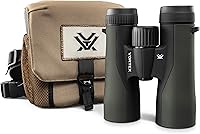
Vortex Triumph HD 10x42: for open-country viewing
The Triumph is the choice here for buyers who regularly watch across fields, coastlines or open hillsides. Its extra magnification has a purpose when subjects remain distant and you have time to settle the view.
It uses fully multi-coated lenses, an HD optical system and a rubber-armored polycarbonate chassis. Vortex says the optical design reduces color fringing and supports resolution and color fidelity.
The included neck strap and adjustable GlassPak harness give you carry options from the start. That suits someone who wants binoculars ready against the chest while walking rather than stored inside a bag.
Adjustable rubber eyecups and a diopter let you set eye position and account for differences between your eyes. The 17 mm eye relief is a useful starting point for fit, including with glasses.
Buy it for reach and an included harness. Its tripod adaptability also gives you a route to steadier viewing from a fixed position.
Skip it if your main problem is finding moving subjects or controlling hand shake. In those cases, an 8x model is the more useful choice even if the subject appears smaller.
Vortex backs the Triumph with its transferable lifetime VIP Warranty. The promise excludes loss, theft, deliberate damage and cosmetic damage that doesn't affect performance, so secure the carry straps before heading out.
Vortex Crossfire HD 8x42: for mixed outdoor use
The Crossfire suits a buyer who wants one pair for changing subjects and varied outings. Its center focus control lets you adjust as attention shifts between a nearby tree and a distant hillside.
It combines fully multi-coated lenses with an HD optical system and a roof-prism layout. Rubber armor provides grip and outer protection, while included lens covers help shield the glass between uses.
The package includes GlassPak carry gear, a neck strap and a lens cloth. This gives a beginner a practical starting setup without making accessories the first research task.
Buy it for general outdoor viewing if the eyepieces fit you well. It also supports a tripod or car window mount for longer watches from one position.
Its 14 mm eye relief is the main reason glasses wearers should pause before choosing it. If your glasses hold your eyes too far from the eyepieces, you'll lose part of the scene.
Skip it if seeing the full view with glasses is your top priority and you cannot confirm the fit. The Nikon offers a longer eye-relief specification among these options.
Vortex also backs the Crossfire with its transferable lifetime VIP Warranty, subject to the exclusions described above. Warranty coverage is useful, but routine lens and strap care still matter.
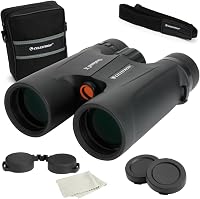
Celestron Nature DX 8x42: for gardens and nearby wildlife
The Nature DX is the most useful starting point here for people who watch feeders, butterflies and other nearby subjects. Its 6.5 ft close focus gives it a clear role beyond distant landscapes.
Measure the distance from your usual viewing spot to the feeder or flower bed. Close focus matters only if the subject falls within a range the binoculars can bring into focus.
Fully multi-coated lenses and phase-coated BaK-4 prisms are part of its optical design. Its rubber-armored polycarbonate body provides a protected grip for outdoor use.
Buy it if your interest shifts between garden details and birds farther away. The broad angular view in the product box also helps when scanning branches for movement.
Twist-up eyecups let you adjust eye position with or without glasses. The package includes a carrying case, neck strap, lens cloth, objective cap and rainguard.
Skip it if reducing carry weight is your first concern. At 1.8 lb, it is heavier than the Nikon's stated 1.3 lb, a difference worth considering for long walks.
The built-in tripod socket supports longer sessions, but the adapter is separate. Celestron includes a Limited Lifetime US Warranty and US-based support, so check the terms that apply where you live.
Nikon PROSTAFF P3 8x42: for glasses wearers
The PROSTAFF P3 is the first model here to compare if glasses make binoculars difficult to use. Its extra-long eye relief gives you more room behind the eyepieces to see the scene.
Turn-and-slide eyecups help set that distance, and a central focus wheel handles changes in subject range. The body uses fiberglass-reinforced polycarbonate with rubber armor.
Multilayer-coated lenses and a silver-alloy prism coating form part of the optical system. The included case, caps and neck strap cover basic storage and carry needs.
Its field of view spans 377 ft at 1,000 yd, giving you a clear distance-based measurement for comparison. That is useful for judging how much landscape fits in the view rather than relying on the word “wide.”
Buy it if glasses fit and lower carry weight lead your decision. It also suits a shared household pair when users can reset the eyecups, hinge and diopter for their own eyes.
Skip it if you mainly need higher magnification across open terrain or close focus is your deciding feature. The Triumph addresses the first need, while the Nature DX provides a stated nearby focusing distance.
Nikon rates the P3 as waterproof down to 3.3 ft and says it is not intended for underwater use. Treat that protection as insurance against wet conditions, not an invitation to immerse it.
How should you choose binoculars for a trip?
Choose travel binoculars around your viewing platform, bag space and likely subjects. A pair that works from a stable overlook may feel much harder to use from a moving deck.
For a cruise, expect wind, spray and motion to affect the view. Keep the strap attached and wait for a steadier moment rather than trying to follow wildlife while walking along the deck.
Our best binoculars for Alaska cruises guide focuses on that setting. Before packing, make sure the case fits where you can reach it during wildlife stops.
For a safari, consider how often the vehicle will stop and how much room you'll have around your seat. Keep binoculars ready without allowing straps to catch on bags, doors or nearby passengers.
See the best binoculars for safari for that use. A comfortable scanning view matters when animals are partly hidden or spread across a broad landscape.
For hiking, count the whole carry setup, including case and harness. Put the binoculars on with your backpack so you can check whether the straps overlap or the case blocks access to a pocket.
How do you set up binoculars for a clear view?
Set hinge width, eyecup position and diopter before judging image quality. Poor adjustment can create dark edges, eye strain or blur that has little to do with the optics.
Follow the instructions for your model, since control locations and adjustment methods can differ. A few quiet minutes at a fixed subject are more useful than making every adjustment while following a bird.
- Secure the strap. Check its threading and connections before lifting the binoculars over hard ground.
- Set the hinge width. Move the barrels until both eyes see one round image instead of two overlapping circles.
- Adjust the eyecups. Start lower with glasses and farther out without them, then change position until the view is full and relaxed.
- Set the diopter. For a typical center-focus design, focus the non-diopter side first, then adjust the diopter side without changing center focus.
- Check both eyes together. Use the center wheel to focus on another subject and confirm that neither eye needs extra effort.
Choose a stationary subject with fine detail, such as tree bark or lettering at a safe distance. Avoid looking toward the sun or bright reflections while adjusting.
Once the diopter suits your eyes, leave it in place during normal focusing. Reset it when another person uses the binoculars or your vision correction changes.
Our guide to focusing binoculars explains the sequence in more detail. Persistent double images after correct adjustment call for help from the brand rather than forcing your eyes to compensate.
How can you see more detail without buying more magnification?
Improve subject finding and steadiness before assuming you need higher power. A stable view often shows more useful detail than a larger image moving across the scene.
Find the subject with your eyes first and keep looking at it as you raise the binoculars. Searching from scratch through the eyepieces makes a small bird much harder to locate.
Use nearby landmarks when the subject is hidden. A forked branch, pale patch of bark or fence post gives you a reference point you can find again.
Keep your elbows near your body and hold the binoculars without squeezing. If possible, sit down and support your elbows on your knees during a longer watch.
Resting your arms against a stable support can also help. Avoid pressing the binoculars hard against vibrating surfaces, since movement can pass straight into the view.
Scan in sections rather than sweeping quickly across the whole scene. Pause at each section long enough to notice small movements, then move to the next area.
For casual night-sky viewing, support your arms and allow your eyes time to adjust to darkness. Binoculars can show broader star fields, but they aren't the right tool for detailed views of planets.
Never point binoculars at the sun. Ordinary binoculars concentrate sunlight and can cause permanent eye injury.
How should you care for binoculars between outings?
Protect the glass from grit and remove loose debris before wiping. Dust trapped under a cloth can scratch a lens or damage its coating.
Use caps during transport and keep the cloth clean in its own pouch. A cloth carried loose in a sandy pocket can bring grit back onto the lens.
Use an appropriate blower or soft lens brush first, then follow the brand's instructions for optical cleaner and wiping. Shirt fabric, paper towels and household glass cleaner are poor substitutes for lens-care materials.
Our binocular cleaning guide explains the order and tools. Clean when needed rather than polishing the lenses every time you pick up the binoculars.
After rain, dry the outside before closing the binoculars inside a case. Leave the case open in a dry place until the gear is dry, especially around eyecups and strap attachments.
Let cold binoculars warm gradually after bringing them indoors. Repeated wiping won't solve condensation while the glass remains colder than the surrounding air.
Check straps, buckles and caps before each trip. Don't take the body apart or try to adjust internal alignment yourself.
What common buying mistakes should you avoid?
Avoid buying for the biggest number or the longest feature list. Start with the job you need the binoculars to do, then remove options that don't fit your eyes, hands or carry plans.
- Choosing power for rare situations. Buy for your usual woods, garden or shoreline rather than one distant subject you might see.
- Ignoring glasses fit. A sharp center image doesn't help if you lose much of the surrounding view.
- Comparing mismatched measurements. Field widths need the same reference distance to support a useful comparison.
- Forgetting nearby subjects. A pair aimed at distant wildlife may not focus on a feeder just outside your window.
- Counting only the binocular weight. The case, harness and overlap with backpack straps affect carry comfort too.
- Assuming an adapter is included. Tripod-ready binoculars can still need a separate part to attach to your support.
- Relying on rubber armor alone. Grip and outer protection don't prevent every impact from affecting alignment.
If possible, check the fit in a shop or compare with a pair you already know. Raise the binoculars several times, use the focus control and look around the image edges with your normal glasses on.
For a pair that several people will share, ease of resetting controls matters. Each user needs their own hinge width, eyecup position and diopter setting.
Which of these best binoculars should you pick?
Choose the best binoculars for your main constraint: reach, glasses fit, nearby focus or everyday use. Settle that need first, then check carry comfort before ordering.
Pick the Vortex Triumph HD 10x42 when distant subjects are routine and you can brace or support the view. Its included harness suits walks where you want the binoculars ready against your chest.
Choose the Vortex Crossfire HD 8x42 for mixed outdoor viewing if its eyepieces fit you comfortably. It is a practical route for someone who wants center focus and carry gear in one package.
Choose the Celestron Nature DX 8x42 when garden wildlife and feeders matter alongside distant birds. Its nearby focusing ability gives you a specific reason to choose it over a pair selected only for reach.
Start with the Nikon PROSTAFF P3 8x42 if you wear glasses or want the lighter stated weight compared with the Nature DX. Confirm that you see the full image without pressing the eyepieces against your frames.
If you still have two suitable choices, favor the one you can carry and use with less effort. Use our guide to choosing binoculars to work through the remaining fit and size decisions.
Frequently asked questions
What are the best binoculars for general outdoor use?
The best binoculars for general outdoor use are usually 8x42 models that fit your eyes and hands comfortably; this size gives useful reach without making hand shake as noticeable as higher powers. Choose among models by eye relief, field of view, carry weight and protection from wet weather.
Are 8x42 or 10x42 binoculars better?
Choose 8x42 for easier handheld viewing and 10x42 for distant subjects when you can hold the image steady. Both have the same objective diameter, but magnification changes how easy it is to find and follow a subject; your usual viewing distance matters more than choosing the higher number.
What binoculars work well for birding?
An 8x42 pair is a useful starting point for birding, especially when birds move through trees or appear at different distances; prioritize a broad field of view, comfortable eyecups and easy focus adjustment. For feeders, butterflies and garden wildlife, compare close-focus distance as well as long-distance reach.
Do binoculars need to be waterproof?
Waterproof construction is worth prioritizing for regular outdoor use because rain, spray and wet vegetation are hard to avoid. Fogproof construction addresses moisture inside the binoculars, while outside surfaces can still mist over; neither feature makes every pair suitable for immersion, so follow the brand's limits and care instructions.
What does 10x42 mean on binoculars?
10x42 means 10x magnification with front objective lenses measuring 42 mm across; a subject appears about 10 times larger in angular size than it does without magnification. The numbers describe reach and lens diameter, but they don't tell you the field of view, comfort or optical quality.