7 Best Binoculars for Hunting (October 2026)
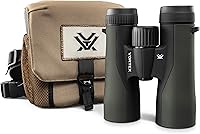
The best binoculars for hunting include the Vortex Triumph HD 10x42 for mixed-terrain hunters, the Vortex Crossfire HD 10x42 for supported field scans, and the Vortex Crossfire HD 12x50 for open-country glassing.
On this page (11 sections)
- How we chose hunting binoculars
- Compare the best binoculars for hunting
- Which hunting binoculars fit your style?
- What magnification works for your hunting terrain?
- Do larger objective lenses help at dawn and dusk?
- What should glasses wearers check before choosing?
- How should you carry and support hunting binoculars?
- How do you set up hunting binoculars correctly?
- How do you glass more effectively and avoid common mistakes?
- How do you protect binoculars from rain, grit and condensation?
- Which hunting binoculars should you choose?
The best binoculars for hunting for most people are the Vortex Triumph HD 10x42, thanks to adjustable viewing settings, weather protection and an included harness. Choose a 12x50 pair if your hunts center on long, supported looks across open country.
Start with how you hunt, rather than the largest magnification number. Binoculars that stay comfortable and ready on your chest are more useful than a powerful pair you leave in your pack.
For other uses, see our binoculars guide for birding, hunting and travel. If deer are your main quarry, our deer hunting binoculars picks narrow the choice around that use.
Our picks at a glance
-
1

-
2
-
3

How we chose hunting binoculars
We prioritized terrain fit, viewing comfort and field readiness, then compared optics, weather protection and carry gear. The Triumph leads because its included harness and adjustable fit make a complete starting setup for varied hunts.
A hunter walking between short viewing stops needs different gear from someone sitting above a broad valley. That difference shapes the recommendations more than any single coating or lens measurement.
These picks cover general hunting and open-country viewing, but none is an automatic fit for every hunter. If your normal view is a nearby gap in thick timber, consider a lower-power format before committing to this group.
Compare the best binoculars for hunting
Choose 10x42 for frequent hand-held scans or 12x50 for more detail from a supported position. Use the table to check eye relief and weather protection, then weigh those features against the way you'll carry the binoculars.
| Product | Best for | Magnification and lens size | Eye relief | Weather protection | Our score |
|---|---|---|---|---|---|
| Vortex Triumph HD 10x42 | mixed-terrain hunters | 10x42 | 17 mm | Waterproof and fogproof | 9.0 |
| Vortex Crossfire HD 10x42 | supported field scans | 10x42 | 15 mm | Waterproof and fogproof | 8.7 |
| Vortex Crossfire HD 12x50 | open-country glassing | 12x50 | 15 mm | Waterproof and fogproof | 8.7 |
| Vortex Diamondback HD 12x50 | dusty overlooks | 12x50 | 14 mm | Waterproof and fogproof | 8.4 |
| Bushnell H2O Xtreme 10x42 | wet-weather hunts | 10x42 | 17 mm | IPX7 waterproof and nitrogen purged | 8.2 |
| Celestron Outland X 10x42 | fixed-position wildlife watching | 10x42 | 15 mm | Waterproof and nitrogen purged | 7.8 |
| Bushnell Engage X 10x42 | hunters wearing glasses | 10x42 | 18 mm | IPX7 waterproof and nitrogen filled | 7.7 |
The size label doesn't settle comfort or pack weight. A smaller objective lens can still come in a heavier body, and longer eye relief can matter more than extra power if glasses keep you from seeing the whole view.
Which hunting binoculars fit your style?
The Triumph HD is the strongest general starting point, while the other picks suit more specific needs. Each profile explains the buyer who should consider it and the tradeoff that could rule it out.
Vortex Triumph HD 10x42: Best for mixed-terrain hunters
- Fully multi-coated optics
- Adjustable eyecups and diopter
- Waterproof and fogproof
- GlassPak harness included
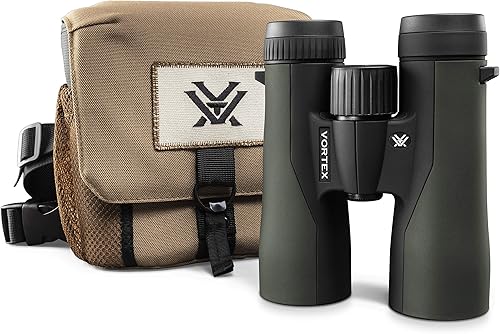
The most complete starting setup here for hunters who walk, stop and scan. Adjustable viewing settings and an included GlassPak harness help with fit and access.
Pros
- Harness and neck strap included
- Adjustable eyecups and diopter
- Tripod adaptable
Cons
- Less reach than the 12x options
- Full-size body needs a dedicated carry space
Vortex Triumph HD 10x42: best hunting binoculars for mixed terrain
The Triumph HD suits hunters who walk, stop and scan through a mix of woods, clearings and open edges. Its included adjustable GlassPak harness gives you a place to keep the binoculars accessible between stops.
Fully multi-coated optics, adjustable eyecups and a diopter cover the main viewing features. The rubber-armored polycarbonate body is nitrogen purged, and Vortex describes the construction as waterproof, fogproof and shockproof.
Its 17 mm eye relief gives glasses wearers a reason to consider it ahead of shorter-relief options here. Set the eyecups to match your viewing position before judging whether the fit works.
Choose this pair if you're building a hunting setup from scratch and want carry gear included. Skip it if distant, stationary glassing is your main task and you already plan to bring a support.
For context on the wider range, read our Vortex binoculars overview. The included harness is a practical reason to choose this model, rather than proof that its view will suit every eye.
Vortex Crossfire HD 10x42: Best for supported field scans
- Fully multi-coated optics
- Center focus and right-side diopter
- Tripod adaptable
- GlassPak carry gear included
A practical option for hunters who alternate between hand-held scans and a mounted view. It supports a tripod or car window mount and includes GlassPak carry gear.
Pros
- Tripod and car window mount compatible
- Twist-up eyecups
- Rubber armor for grip
Cons
- Shorter eye relief than the Triumph
- Mounting requires a compatible support setup
Vortex Crossfire HD 10x42 for scans from a rest
The Crossfire HD 10x42 fits hunters who switch between carrying and supported viewing. It can attach to a tripod or car window mount, making it useful for watching a field edge or scanning from a parked vehicle.
Twist-up eyecups, a center focus wheel and a right-eyepiece diopter let you set each side for your eyes. Rubber armor adds grip, while nitrogen purging and O-ring seals provide waterproof and fogproof construction.
The 15 mm eye relief is the main fit caution, especially with glasses. Check that you can see the full circular view without pressing your frames hard against the eyecups.
Choose it when you want a general hunting format with mounting flexibility and included GlassPak carry gear. Skip it if glasses fit is uncertain, since the Triumph and Engage X offer longer eye relief.
Our Crossfire HD 10x42 review takes a closer look at the model. Center focus is useful, but it isn't a reason by itself to choose this pair over other center-focus binoculars.
Vortex Crossfire HD 12x50: Best for open-country glassing
- 12x magnification
- 50 mm objective lenses
- Tripod adaptable
- GlassPak harness included
A fit for hunters who settle into an overlook and examine distant slopes. Plan for supported viewing to make better use of the extra magnification.
Pros
- More magnification for distant subjects
- Tripod and car window mount compatible
- Carry harness included
Cons
- Weighs 1.8 lb
- Hand movement is more visible at 12x
Vortex Crossfire HD 12x50 for open slopes
The Crossfire HD 12x50 suits hunters who spend long periods studying distant ground. Its extra magnification is most useful when you're seated, braced or using a tripod rather than trying to scan while standing unsupported.
It combines 12x magnification and 50 mm objective lenses with fully multi-coated optics. Tripod and car window mount compatibility give you ways to steady the image for repeated looks at the same slope.
At 1.8 lb, the binoculars deserve a deliberate place in your carry plan. Add the support equipment to your total load before deciding that this is the right format for a long walk.
Choose it for a hunt built around overlooks, broad basins or distant field margins. Skip it if you mostly follow nearby movement through brush or want quick views without finding a stable position.
Use the included harness to keep the binoculars close while walking. At your glassing spot, settle the support and focus before studying small details; an enlarged but moving image can hide what you're trying to see.
Vortex Diamondback HD 12x50: Best for dusty overlooks

- Dielectric prism coating
- Armortek exterior lens coating
- Argon purged
- GlassPak harness included
A supported-glassing choice with an exterior lens coating that Vortex says protects against scratches, oil and dirt. Its short eye relief deserves close attention if you wear glasses.
Pros
- Armortek exterior lens coating
- Tripod adaptable
- Dielectric coating
Cons
- Weighs 1.8 lb
- Shortest eye relief among these picks
Vortex Diamondback HD 12x50 for exposed glassing spots
The Diamondback HD 12x50 suits supported viewing where lens care is a regular concern. Vortex says its Armortek exterior coating protects against scratches, oil and dirt, which gives this model a clear reason to consider it for dusty overlooks.
It also has dielectric coating, fully multi-coated lenses, argon purging and O-ring seals. The body is rubber armored, tripod adaptable and supplied with a GlassPak harness.
Its 14 mm eye relief is the shortest in this group, so glasses wearers should make fit a deciding factor. The binoculars weigh the same as the Crossfire HD 12x50, making the coating package and eye relief more useful distinctions than weight.
Choose it if you want this higher-power format and value exterior lens protection. Skip it if you struggle to see the view edges through your glasses or need an optic mainly for unsupported scans.
Our Vortex Diamondback HD 8x42 review covers a different size in the family. Don't assume that model's handling or viewing fit carries over to this larger pair.
Bushnell H2O Xtreme 10x42: Best for wet-weather hunts

- IPX7 waterproof protection
- Nitrogen purged
- Fully multi-coated optics
- Soft non-slip grips
A sensible choice around wet brush, boats and standing water. IPX7 protection and soft non-slip grips address both water exposure and handling.
Pros
- IPX7 waterproof protection
- 17 mm eye relief
- Strap, case and covers included
Cons
- Weighs 709 g
- Confirm mounting compatibility if a tripod is essential
Bushnell H2O Xtreme 10x42 for wet ground
The H2O Xtreme fits hunters who put water protection near the top of their checklist. Its O-ring sealed optical system carries an IPX7 rating, and nitrogen purging helps prevent internal fogging.
Soft non-slip grips and rubber armor address handling when your hands or gear are wet. Bushnell includes a strap, carrying case and lens covers, so you have basic protection for travel between viewing stops.
The optics use BaK-4 prisms and fully multi-coated glass surfaces. Its 709 g weight is worth considering if you expect to wear it throughout a long day on foot.
Choose it for wet brush, rainy field edges or trips where accidental immersion is a concern. Skip it if a confirmed tripod setup is central to your plans and you haven't established mounting compatibility.
The IPX7 rating is a useful distinction, but keep the lenses covered when you're moving through rain. A sealed body can protect the inside while water droplets on the outside still interfere with the view.
Celestron Outland X 10x42: Best for fixed-position wildlife watching
- Multi-coated optics
- BaK-4 prisms
- Tripod adapter threads
- Waterproof and nitrogen purged
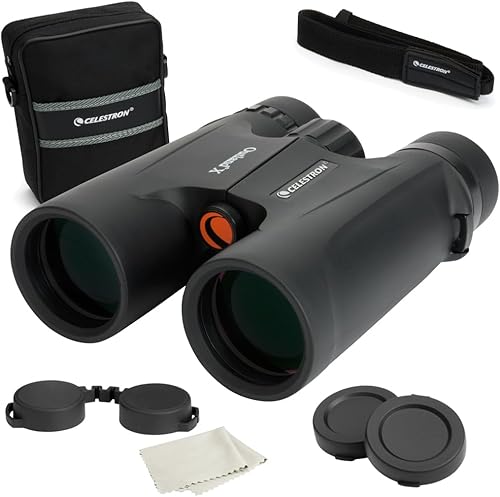
An option for hunters who also watch wildlife from a regular observation spot. Built-in adapter threads support mounting, but the separate adapter adds to your gear needs.
Pros
- Tripod adaptable
- Rubber-armored polycarbonate housing
- Case, strap and covers included
Cons
- Weighs 2 lb
- Tripod adapter not included
Celestron Outland X 10x42 for a regular observation spot
The Outland X suits hunters who also watch wildlife from a fixed spot and want the option to mount their binoculars. Built-in tripod adapter threads support that plan, though the adapter is not included.
It uses multi-coated optics and BaK-4 prisms in a rubber-armored polycarbonate housing. Waterproof construction and nitrogen purging address rain and internal fogging, while the included case, covers and rainguard help protect it between uses.
At 2 lb, this is the heaviest pair here despite its general hunting format. That makes it a less appealing choice for someone trying to reduce the load carried on long approaches.
Choose it if you're comfortable with the weight and will make use of its mounting option. Skip it if your main priority is an easy all-day chest carry.
Allow room for the adapter and support in your gear plan. Once mounted, set the viewing height so you can look through both barrels without hunching or holding your neck at an awkward angle.
Bushnell Engage X 10x42: Best for hunters wearing glasses

- 18 mm eye relief
- EXO Barrier exterior coating
- IPX7 waterproof protection
- Tripod compatible
The first option to consider here if glasses fit is your main concern. It combines the longest eye relief in this group with twist-up eyecups and a protective exterior coating.
Pros
- Longest eye relief among these picks
- IPX7 waterproof protection
- EXO Barrier exterior coating
Cons
- Glasses fit still needs a personal check
- Included carry gear is a strap and case
Bushnell Engage X 10x42 for glasses fit
The Engage X is the first pair here to consider when glasses fit leads your decision. Its 18 mm eye relief is the longest in this group, and twist-up eyecups let you adjust the viewing position.
Bushnell says EXO Barrier repels water, oil, fog, dust and debris from exterior lens surfaces. The binoculars also have fully multi-coated optics, IPX7 waterproof protection and nitrogen filling.
At 620 g, they are lighter than the H2O Xtreme. A neck strap and carrying case are included, and tripod compatibility adds an option for longer viewing stops.
Choose them if seeing the full view through your glasses matters more than getting an included harness. Skip them if you want the carry setup supplied with the top Vortex picks and don't need the extra eye relief.
Keep your glasses on during a fit check if that's how you'll hunt. A comfortable view should stay clear across the visible circle without requiring you to tilt your head or force the eyecups against your frames.
What magnification works for your hunting terrain?
Match magnification to your usual view, with 10x as a starting point for mixed ground and 12x for distant, supported observation. Close cover can favor lower power because you need to find an animal quickly before it disappears behind trees.
Across open country, extra magnification can help you examine a shape you've already spotted. It also enlarges hand movement, so support becomes more valuable as you spend longer looking at one place.
Don't choose power from the farthest animal you might ever see. Choose for the distances you glass most often, then decide whether rare distant observations justify carrying another optic.
Field of view matters during the search itself. A wider view helps you locate movement and keep track of landmarks, while a narrower view calls for more deliberate scanning.
For help reading size labels, see what the numbers on binoculars mean. Magnification describes image enlargement, not a fixed distance at which you can identify an animal.
Do larger objective lenses help at dawn and dusk?
Larger lenses collect more light, but magnification changes how that light reaches your eyes. Compare the whole format instead of assuming every larger binocular will look brighter.
Exit pupil is objective diameter divided by magnification. A 10x42 produces about a 4.2 mm exit pupil, while a 12x50 produces about 4.17 mm, so these formats are very close by that measure.
That means the larger lenses on the higher-power pair don't create a large exit-pupil advantage. Coatings, optical design, your eyes and viewing conditions also affect the usable view.
In dim light, hold the image steady and refocus carefully before deciding you need more power. A shaky view or slightly wrong focus can make a dark animal harder to separate from shaded brush.
These are daylight optics, and low-light claims don't turn them into night-vision devices. End an observation when you can no longer identify what you're seeing with confidence.
What should glasses wearers check before choosing?
Check for a complete, comfortable view while wearing your usual hunting glasses. Eye relief is a useful starting measurement, but frame shape and the distance between your glasses and eyes affect the final fit.
Begin with adjustable eyecups lowered, then move them outward only if that improves the view. Dark crescents or edges that disappear as you shift your head can signal that your eyes aren't in the right position.
The binoculars should form one circular image after you adjust the hinge spacing. You shouldn't need to squeeze the barrels together, tilt your head or press hard against your glasses to hold that image.
If you have astigmatism, your glasses may remain important even after adjusting focus and diopter. Use the same eyewear during setup that you expect to wear in the field.
Also check the controls with gloves. You need to reach focus without losing your grip or pushing the binoculars out of alignment with your eyes.
How should you carry and support hunting binoculars?
Keep binoculars secure, accessible and comfortable enough to wear throughout the hunt. A harness spreads the load across your upper body and can limit swinging when you bend or climb.
Adjust the carry height while wearing your normal layers and pack. The binoculars should come to your eyes without pulling the harness tight across your shoulders or catching on straps.
A neck strap can work for shorter outings, but consider how the weight feels over several hours. Avoid leaving long loose loops that can snag on brush or other gear.
For supported viewing, rest your elbows on your knees or another stable surface before adding more equipment. Keep hard pressure off the lenses and avoid resting the binoculars where a slip could send them to the ground.
If you plan to mount them, check the binocular adapter, support head and total load together. Tripod compatibility doesn't mean every part needed for mounting comes in the box.
How do you set up hunting binoculars correctly?
Set hinge spacing, eyecups and diopter before your first hunt, then use the main focus wheel as viewing distances change. A few minutes spent on fit can prevent constant readjustment in the field.
- Set the eyecups for your eyes. Start lower with glasses and farther out without them, then adjust until the full view is comfortable.
- Adjust the hinge spacing. Move the barrels until the 2 views merge into one circle.
- Focus the left side. For a common right-side diopter design, cover the right objective and use the center wheel on a detailed, stationary subject.
- Match the right side. Cover the left objective and adjust the right diopter while leaving the center focus alone.
- Recheck with both eyes. Confirm a sharp, relaxed view, then note the diopter position in case it gets moved.
Follow the instructions supplied with your binoculars if their control layout differs. Our guide to focusing binoculars explains the process in more detail.
Choose a sign, branch or other clear target at a useful distance for setup. Never look at the sun through binoculars.
How do you glass more effectively and avoid common mistakes?
Stop moving, steady the binoculars and search in a planned pattern. Rushing across the whole landscape makes it easy to miss a small patch of movement or overlook the same strip repeatedly.
Start with a broad look using your unaided eyes, then choose a landmark where you'll begin. Scan in overlapping strips and pause around shade lines, openings and partly hidden shapes.
When you spot something, keep track of a nearby landmark before lowering the binoculars. That makes it easier to find the same place again after changing position or speaking to a companion.
Refocus as you move between near brush and distant slopes. Leaving focus set for one distance can hide useful detail at another.
Avoid gripping harder to fight shake, which can add tension and fatigue. Brace your elbows, sit down or use a support when possible.
Don't use a firearm's scope to search for unidentified movement. Binoculars let you observe without pointing a firearm at something you haven't identified.
The biggest buying mistake is choosing extra power before solving fit and stability. A clear view you can hold comfortably is more useful than a larger image that keeps moving.
How do you protect binoculars from rain, grit and condensation?
Use covers during travel and remove grit before wiping a lens. Waterproof seals protect the inside, while careful handling protects the surfaces you look through.
Nitrogen or argon purging helps prevent internal fogging, but outside glass can still collect condensation. After a temperature change, allow the binoculars to adjust and clear before repeated wiping.
Brush or blow away loose particles with tools made for optics. Then use a clean lens cloth and suitable lens cleaner according to the binocular maker's care instructions.
A shirt hem can hold dust, and wiping muddy glass can drag grit across a coating. Keep your cleaning cloth in a clean pouch rather than loose in the bottom of a hunting pack.
Let wet carry gear and binocular exteriors dry before closed storage. Our binocular lens cleaning guide covers the cleaning steps and materials to use.
Which hunting binoculars should you choose?
The best binoculars for hunting are the pair that fit your terrain, eyes and carry routine. Use your most common hunting day to make the final choice, rather than planning around an occasional extreme distance.
Choose the Triumph HD for a general setup with an included harness. Pick the Crossfire HD 10x42 if you want to alternate between hand-held viewing and a supported position.
Choose the Crossfire HD 12x50 for open-country observation where you'll make time to steady the view. Consider the Diamondback version when its exterior coating matters and the shorter eye relief works for you.
Favor the H2O Xtreme for wet conditions or the Engage X when glasses fit is the first concern. The Outland X fits a fixed observation routine better than a hunt focused on reducing carry weight.
Before ordering, settle 3 things: where you'll glass, what you'll wear over your eyes and how you'll support the binoculars. If close woodland viewing still leaves you unsure about power, read 8x42 vs 10x42 binoculars before choosing.
Our top 3 picks at a glance
-
1
-
2
-
3
Frequently asked questions
What magnification is best for hunting binoculars?
10x is a useful starting point for mixed terrain, while 12x suits distant glassing from a stable position. For close woodland encounters, lower power can make finding moving animals easier.
Choose for your usual viewing distance and support plan, since extra magnification also makes hand movement more visible.
Are 10x42 binoculars good for hunting?
Yes, 10x42 binoculars suit many hunting situations, especially when you stop to scan fields, clearings and slopes. They balance useful reach with a format you can carry between viewing stops.
Check weight, eye relief and handling before choosing, because the same size label does not mean the same fit.
Should I choose 10x42 or 12x50 binoculars for hunting?
Choose 10x42 for frequent hand-held use and 12x50 for longer, supported looks across open ground. Extra magnification helps only when you can keep the image steady enough to study details.
If you mostly hunt close cover, our 8x42 vs 10x42 comparison explains why less power can be useful.
Do hunting binoculars need to be waterproof?
Waterproof construction is worth choosing for rain, wet brush and damp storage conditions. Internal fog protection matters too, but neither feature prevents every drop or patch of condensation on an outside lens.
Use covers during travel and read our guide to waterproof and fogproof binoculars for the differences.
Can you use binoculars instead of a spotting scope for hunting?
Binoculars can be your only optic when they show enough detail at your usual distances. A spotting scope becomes useful when finding an animal is easy but judging distant details requires more magnification.
Our binoculars vs spotting scope guide explains how viewing distance, support and pack space affect that choice.