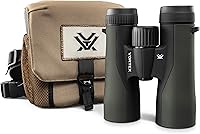
Are Vortex Binoculars Good?
Yes, Vortex binoculars are good choices for outdoor viewing when you match the model to your needs. Choose the Diamondback HD 8x42 for birding, a 10x42 for distant daytime subjects, or the Crossfire HD 12x50 for supported viewing.
On this page (6 sections)
Yes, Vortex binoculars are good choices for birding, hiking, and hunting if you choose the right magnification and fit. The Diamondback HD 8x42 is the strongest general birding option here, while the 10x42 models suit more distant subjects.
The Crossfire HD 12x50 serves a narrower purpose: longer-distance viewing where you can brace your arms or use a mount. More power helps only when you can keep the image steady.
These four models share weather protection and useful viewing adjustments. Their differences matter more than the Vortex name alone.
Are Vortex binoculars good quality?
These Vortex models have practical features for regular outdoor use, including fully multi-coated lenses, rubber armor, and waterproof and fogproof construction. Each also has center focus, adjustable eyecups, a diopter adjustment, and tripod adaptability.
Vortex says their HD optical systems use optimized glass elements to improve resolution and color fidelity while reducing color fringing. The HD label alone doesn't establish how much detail separates one model from another.
The Diamondback adds dielectric and Armortek coatings. Vortex says the dielectric coating supports bright, color-accurate images, while Armortek protects exterior lenses from scratches, oil, and dirt.
For a first look at size labels, read what the numbers on binoculars mean. Our binoculars guide puts these choices alongside options for other viewing tasks.
Are Vortex binoculars good for everyday use?
Yes, if the binoculars fit your eyes and your routine. Comfortable eyecups, a steady image, and easy access on a walk matter more than choosing the highest magnification.
For woodland birds and casual nature walks, start with lower power. For animals across open fields, extra magnification can be useful because you spend less time searching nearby branches.
Which Vortex binoculars should you choose?
Start with the subject and viewing distance, then consider glasses fit and carrying weight. These four models cover different needs, so there isn't one best choice for every outing.
Who should buy the Vortex Triumph HD 10x42?
Choose the Triumph for occasional outdoor viewing and a ready-to-carry package. Its polycarbonate chassis has full rubber armor, and it comes with an adjustable GlassPak harness, neck strap, lens covers, and cloth.
The included harness is useful if you want the binoculars within reach during a hike rather than buried in a backpack. Adjust it before leaving home so the binoculars stay close to your chest without restricting access.
Its 17 mm of eye relief gives glasses wearers a useful starting point, though frame shape still affects fit. Skip this model if your main goal is following nearby birds through dense branches, where the Diamondback's lower power is a better match.
If you already want this size, use our Vortex Crossfire HD vs Triumph HD comparison to narrow the choice. Don't choose between them on chassis material alone.
Who should buy the Vortex Diamondback HD 8x42?
Choose the Diamondback for handheld birding and general nature walks. Its 8x magnification is easier to keep steady than higher powers, and its field of view covers 393 feet at 1,000 yards.
That broad view helps when you raise the binoculars toward a bird you first spotted with your eyes. It also gives a moving subject more room before it leaves the image.
The added lens coatings are a reason to consider this model if you regularly use binoculars outdoors. They don't remove the need for lens caps or careful cleaning.
Skip it if most of your subjects are distant and still, and you specifically want more image scale. For mixed birding trips, our guide to what size binoculars you need for bird watching explains that tradeoff.
Who should buy the Vortex Crossfire HD 10x42?
Choose the Crossfire HD 10x42 for distant daytime wildlife and open-country viewing. Its magnification suits subjects across fields or water, provided you can hold it steadily.
The binoculars weigh 1.4 lb, so consider the whole outing rather than just how they feel for a minute. A harness helps distribute the load, but carrying comfort also depends on strap adjustment and your other gear.
Brace your elbows against your body when viewing, or rest them on a stable surface. This reduces movement without requiring a tripod for every stop.
Skip it if your hands shake enough to obscure detail or your glasses prevent a full view through the eyepieces. See Crossfire HD vs Diamondback HD if you're deciding between more reach and easier handheld viewing.
Who should buy the Vortex Crossfire HD 12x50?
Choose the Crossfire HD 12x50 for deliberate, supported viewing of distant subjects. It suits watching from a fixed position better than quick views during a long walk.
At 1.8 lb, it adds carrying weight compared with the smaller Crossfire. Its higher power also magnifies hand movement, so plan how you'll support it before choosing it.
Larger front lenses don't automatically mean a brighter image. Exit pupil, which is objective diameter divided by magnification, is about 4.2 mm for both Crossfire sizes here.
Skip this model for tracking nearby birds or frequent one-handed use. If you intend to mount it, confirm adapter and mount compatibility before ordering accessories.
Are Vortex binoculars good for glasses wearers?
The Triumph and Diamondback are the better starting points here for glasses wearers, with 17 mm of eye relief. Both Crossfire models provide 15 mm, which leaves less room between the eyepiece and your eye.
Start with the eyecups lowered while wearing glasses. Adjust the hinge until both barrels form one round image, then check whether you can see the full circular edge without pressing your glasses against the eyepieces.
Black crescents or a cut-off view can mean your eye position needs adjustment. Move the binoculars slightly closer or farther away and change the eyecup position before blaming the optics.
Eye relief numbers help narrow the options, but they can't account for every frame shape. Our guide to binocular eye relief explains the fit checks.
How should you set up and focus Vortex binoculars?
Set the hinge, eyecups, and diopter before judging image quality. A diopter mismatch can leave one eye blurry even when the center focus seems correct.
- Look at a stationary subject and adjust the hinge until you see one circular image.
- Set the eyecups for a comfortable view, usually lower with glasses and higher without them.
- On the Crossfire and Diamondback, cover the right objective lens and focus the left eye with the center wheel.
- Cover the left objective lens and use the right diopter to focus the right eye on the same subject.
- Uncover both lenses and use the center wheel as viewing distance changes.
Keep both eyes open while covering each objective if that feels more relaxed. For the Triumph, follow its diopter instructions rather than assuming its control layout is identical.
Once set for your eyes, the diopter usually stays put until someone else uses the binoculars. Our binocular focusing guide explains the process in more detail.
What mistakes should you avoid with Vortex binoculars?
Avoid buying too much magnification, rubbing dusty lenses, or treating weather protection as permission to neglect care. These mistakes can make a suitable pair harder to use or damage its lenses.
Higher power doesn't guarantee more visible detail in your hands. If the image keeps moving, a steadier lower-power view can be more useful than a larger, unstable one.
Keep looking at a bird with your eyes as you raise the binoculars into position. Looking down at the binoculars first makes small subjects harder to find again.
For cleaning, remove loose grit with a blower or soft optical brush before using lens-safe fluid and a clean lens cloth. Follow our binocular cleaning guide rather than wiping grit away with clothing.
Let wet binoculars dry before closing them inside a case. Gas purging helps prevent internal fogging, but condensation can still form on exterior lenses during temperature changes.
Vortex's transferable lifetime VIP Warranty covers damage or defects through repair or replacement. It excludes loss, theft, deliberate damage, and cosmetic damage that doesn't affect performance, so secure the strap and keep the lens covers handy.
Are Vortex binoculars good for your next trip?
Yes, when you choose around your main use. Pick the Diamondback for handheld birding, the Triumph for occasional outdoor trips with an adjustable carry package, or the Crossfire HD 10x42 for distant daytime subjects.
Choose the Crossfire HD 12x50 only when its extra magnification serves a clear purpose and you have a way to steady it. If you're unsure, prioritize comfort and ease of finding subjects over power.
For a closer look at the birding choice, read the Vortex Diamondback HD 8x42 review. If brand choice is still open, our Vortex vs Nikon binoculars comparison is the next useful step.
Frequently asked questions
Are Vortex binoculars good for beginners?
Yes, these Vortex binoculars have useful beginner features, including center focus, adjustable eyecups, and a diopter adjustment. The Diamondback HD 8x42 is the easiest starting point here for handheld birding because lower magnification makes shake less distracting.
Choose a 10x model when distant subjects matter more than ease of tracking.
Are Vortex binoculars waterproof?
All four models covered here are waterproof and fogproof. Gas purging helps prevent internal fogging, but moisture can still form on the outside of cold lenses when you enter warm air.
No immersion depth or duration is provided here, so use them for outdoor weather rather than underwater viewing.
Which Vortex binoculars are best for bird watching?
The Diamondback HD 8x42 is the strongest fit here for general bird watching. Its 8x magnification is easier to hold steady than higher powers, and its broad view helps you follow moving birds.
Choose a 10x model instead if you mainly watch distant birds across open ground or water.
Does Vortex have a lifetime warranty?
Vortex backs these models with its unlimited, unconditional, transferable lifetime VIP Warranty, promising repair or replacement for damage or defects. The coverage excludes loss, theft, deliberate damage, and cosmetic damage that doesn't affect performance.
It offers useful long-term support, but you still need to protect and keep track of your binoculars.