Vortex Crossfire HD vs Triumph HD 10x42: Which Is Better? (October 2026)
In the Vortex Crossfire vs Triumph comparison, choose the Triumph HD for lighter carry and more room behind the eyepieces. Choose the Crossfire HD if you prefer an aluminum enclosure and its twist-up eyecups fit you comfortably.
On this page (11 sections)
- Vortex Crossfire vs Triumph: what actually changes?
- Which Vortex 10x42 is better for glasses?
- Who should choose the Triumph HD?
- Who should choose the Crossfire HD?
- Are these the right binoculars for your viewing style?
- Does either model have better optics or a wider view?
- How do you set up either pair for a clear view?
- Which carrying setup should you use?
- How should you care for them after rain or dusty use?
- What buying mistakes should you avoid?
- Vortex Crossfire vs Triumph: which should you buy?
In the Vortex Crossfire vs Triumph comparison, choose the Triumph HD for easier carrying and more room between your eyes and the eyepieces. Choose the Crossfire HD if you prefer an aluminum enclosure and its eyecups give you a comfortable view.
For most buyers choosing between these two, the Triumph is the better starting point. The Crossfire makes sense when you like its construction and controls enough to accept extra weight.
Neither model earns an image-quality win from shared optical terms alone. Fit, steady handling and how you carry the binoculars give you firmer reasons to choose.
For nearby alternatives, see our Crossfire HD vs Diamondback HD comparison and our Vortex Crossfire HD review.

Vortex Crossfire vs Triumph: what actually changes?
The useful differences are eye relief, weight and enclosure material. Both are full-size binoculars with the same magnification and objective size, so this decision is mainly about comfort and use.
| Feature | Vortex Triumph HD 10x42 | Vortex Crossfire HD 10x42 |
|---|---|---|
| Magnification and objective | 10x42 | 10x42 |
| Eye relief | 17mm | 15mm |
| Weight | 0.45 kg, about 0.99 lb | 1.4 lb |
| Chassis or enclosure | Polycarbonate chassis | Aluminum enclosure |
| Focus | Center focus; adjustable diopter | Center focus; right-eyepiece diopter |
| Eyecups | Adjustable rubber eyecups | Adjustable, twist up and down |
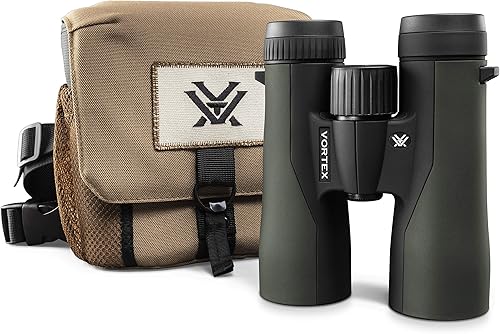
| Carry gear | GlassPak harness and case, neck strap | GlassPak harness and case, neck strap |
| Water and fog protection | Nitrogen purged | Nitrogen purged, O-ring seals |
| Tripod adaptable | Yes | Yes |
Read the table around your main problem. If binoculars usually feel tiring around your neck, weight matters more than enclosure preference.
If you struggle to see the whole image through glasses, start with eye relief. Buyers who mostly watch from a porch, overlook or parked vehicle can give more weight to fit and controls because they carry less.
Which Vortex 10x42 is better for glasses?
The Triumph is the first pair to consider with glasses, thanks to its 17mm eye relief compared with the Crossfire's 15mm. That extra space can help you keep your glasses on while seeing the edges of the view.
Eye relief describes where your eye needs to sit behind the eyepiece to see the full image. Glasses hold your eyes farther away, and thick frames or lenses can use up some of that space.
How should you compare Vortex Crossfire vs Triumph eyecup fit?
Check for a full circular view without pressing hard against your glasses. Both models have adjustable eyecups, and the Crossfire's eyecups twist up and down.
Start with the eyecups lowered when wearing glasses. Bring the binoculars to your normal viewing position, then move them slightly forward and back to find a clear view.
Dark crescents or black patches can mean your eyes are too close, too far away or off-center. Adjust the barrel spacing and eyecups before deciding the binoculars don't fit.
Without glasses, raising the eyecups usually helps hold your eyes at the right distance. Read our binoculars for glasses wearers guide for fit checks, or what eye relief means for the measurement.
Who should choose the Triumph HD?
Choose the Triumph for walking, casual wildlife viewing and shared family outings when low carry weight is your priority. It also deserves the first fit check if you wear glasses.
On a hike, binoculars need to be easy enough to carry that you keep them within reach. A pair buried in your backpack is less useful when a bird or distant animal appears briefly.
The Triumph weighs about 0.41 lb less than the Crossfire. That difference also matters when you repeatedly lift the binoculars, hold them up, lower them and start again.
Use the included adjustable harness when you want the binoculars close to your chest. Set the straps so you can raise them without pulling against your shoulders.
Skip the Triumph if your main goal is a proven step up in sharpness over the Crossfire. The available optical details don't establish that advantage, so choose it for its clear fit and carry benefits.
Who should choose the Crossfire HD?
Choose the Crossfire for viewing from a fixed spot if you prefer its aluminum enclosure and find its controls comfortable. Its extra carry weight matters less when you're near a seat, support or vehicle.
That makes it a sensible option for buyers who watch distant wildlife from an overlook or spend time scanning from one position. It supports a tripod or compatible car window mount for longer sessions.
Its twist-up eyecups let you change the eye position for use with or without glasses. The right-eyepiece diopter handles differences between your eyes after you set the main focus.
An aluminum enclosure is a reason to prefer its construction, but it isn't proof that the Crossfire survives harder knocks than the Triumph. Vortex describes both models as shockproof, without a matching impact limit for this comparison.
Skip the Crossfire if you already dislike heavy gear or have trouble seeing the full view through glasses. Those are daily comfort problems that an enclosure preference won't solve.
Are these the right binoculars for your viewing style?
Both suit buyers who want detail on distant subjects, but neither is an automatic choice for every outing. Magnification also enlarges hand movement, which can make the view harder to hold steady.
For distant wildlife, first find the subject with your eyes, then raise the binoculars without looking away. Starting with the binoculars already at your face often makes a small subject harder to locate.
For birds moving through nearby branches, quick subject finding may matter more than extra detail. If you repeatedly lose the bird while raising your binoculars, reconsider the magnification you need before choosing between these models.
For long sessions, brace your elbows against your body or use a stable support. Neither pair replaces the extra reach of a spotting scope when your main goal is examining very distant details.
The same thinking applies after sunset: don't buy either expecting the view to stay unchanged as light fades. Viewing conditions, a steady hold and your own eyes all affect how much detail you can see.
Does either model have better optics or a wider view?
There is no clear optical winner from the shared features alone. Both have HD optical systems and fully multi-coated lenses, while Vortex claims benefits for resolution, color and light transmission.
Both also have a 4.2mm exit pupil. That is the diameter of the light beam leaving each eyepiece, rather than a separate measure of sharpness.
Matching exit pupils don't prove matching views. Coating labels and HD names also don't tell you how much fine detail each model resolves at the center or edges.
The Crossfire has a field-of-view width of 325 feet, but a width needs its viewing distance to support a fair comparison. A reliable matching measurement for the Triumph isn't available here, so field of view shouldn't decide the winner.
If tracking moving subjects is your main concern, confirm comparable figures with Vortex. Our guide to what the numbers on binoculars mean explains the size terms without confusing them with image quality.
For a wider range of choices, use our binoculars guide. Our Vortex Triumph HD 10x42 review covers that model in more detail.
How do you set up either pair for a clear view?
Set the barrel spacing, eyecups and diopter before judging the image. A poor setup can leave one eye blurred or create black edges even when the main focus seems close.
Follow the model's instructions, then use this basic sequence:
- Set the barrel spacing. Move the hinge until the two views merge into one circle, with both eyes open and relaxed.
- Adjust the eyecups. Begin lowered with glasses and raised without them, then refine the position until the edges stay clear.
- Choose a fixed subject. Use something with fine detail, such as lettering or tree bark, in comfortable daylight.
- Set the main focus for one eye. On the Crossfire, cover the right objective and use the center wheel to sharpen the left-eye view.
- Match the other eye. Cover the left objective and adjust the right-eyepiece diopter without moving the center wheel.
- Open both views. Check the result, then use the center wheel as subject distance changes.
For the Triumph, identify its diopter control and follow its instructions for the matching sequence. Cover an objective rather than squeezing an eye shut if squinting changes your face position.
The diopter compensates for differences between your eyes; it isn't the control to turn every time a subject moves. Our guide to focusing binoculars explains the process in more detail.
If several people share the binoculars, each person may need a different hinge, eyecup and diopter setting. Remembering your settings makes switching back faster.
Which carrying setup should you use?
Use the harness for active walking and choose the neck strap when quick removal and simple access matter more. Both models include GlassPak carry gear, so you can start by checking the included fit.
A harness can spread the load across your upper body and help control movement as you walk. A neck strap is simpler for short stops, but set it so the binoculars don't swing into rocks, railings or other gear.
Check all strap attachments before leaving home. Loose ends should be secured, and the binoculars should rise to eye level without the strap catching on clothing.
For tripod use, confirm the required adapter and mounting fit before your outing. Attach everything while the binoculars are supported, then check that the view stays level and the controls remain reachable.
A mount is most useful when you want to study one area for a while. For quick changes between subjects in different directions, carrying and handholding may be more practical.
How should you care for them after rain or dusty use?
Remove grit before wiping the lenses, and dry the binoculars before closing them inside a case. Weather protection helps during outdoor use, but it doesn't keep dirt off the glass.
Vortex describes both pairs as waterproof and fogproof. Those claims don't provide a shared submersion depth, so follow the model's instructions rather than treating either pair as underwater equipment.
Use a blower or suitable soft brush to lift loose grit. For remaining marks, use lens-safe cleaning materials and a clean cloth, following the care instructions.
Don't rub dusty lenses with a shirt or a cloth that has been loose in a pocket. Grit trapped in fabric can scratch optical surfaces.
Keep the covers on when the binoculars aren't in use, and store the cloth where it stays clean. Our guide to cleaning binoculars without scratching the lenses walks through the order.
Vortex backs both with its transferable lifetime VIP Warranty for repair or replacement of damaged or defective items. It excludes loss, theft, deliberate damage and cosmetic damage that doesn't affect performance.
What buying mistakes should you avoid?
Avoid choosing by HD branding, enclosure material or accessories alone. The best match is the pair you can see through comfortably and keep ready during your usual outing.
Don't assume metal construction proves better image quality or greater impact resistance. Those are separate questions, and the enclosure material doesn't settle them.
Don't keep refocusing to fix dark crescents around the image. Check eye position, barrel spacing and eyecup height first, then adjust sharpness.
Don't choose a heavier pair on the assumption that support will always be available. If most of your viewing happens during a walk, judge the binoculars as something you'll carry and raise repeatedly.
If neither pair fits your eyes or viewing needs, widen the search. Our Vortex Crossfire HD vs Nikon PROSTAFF P3 10x42 comparison offers another path.
Vortex Crossfire vs Triumph: which should you buy?
Buy the Triumph HD when carrying comfort or glasses clearance leads your decision. Buy the Crossfire HD when you prefer its aluminum enclosure, its eyecups fit well and most viewing happens from a fixed spot.
If you already have a comfortable Crossfire, the shared optical features don't establish a reason to switch for a better image. The Triumph becomes more compelling when reducing carry weight solves a problem you actually have.
Before ordering, settle your main use and check fit whenever possible. Then use the individual Crossfire HD review or Triumph HD review to confirm the model's details.
For the final comfort check in this Vortex Crossfire vs Triumph decision, follow our guide to binocular eye relief. A full, relaxed view matters every time you raise the binoculars.
Frequently asked questions
What is the difference between Vortex Crossfire and Triumph?
The main differences are carry weight, eye relief and enclosure material. The Triumph uses a polycarbonate chassis and offers more eye relief with less weight.
The Crossfire has an aluminum enclosure and twist-up eyecups.
Their shared optical features don't establish a clear winner for image quality.
Which Vortex 10x42 is better for glasses?
Start with the Triumph HD because its 17mm eye relief gives more room than the Crossfire HD's 15mm. Keep your glasses on, lower the eyecups and check that you can see the full circular view.
Choose by that fit check, since frame shape and lens position also matter.
Are Vortex Crossfire HD and Triumph HD both waterproof?
Vortex describes both as waterproof and fogproof, and both use nitrogen purging. The Crossfire also has O-ring seals.
Keep the lenses covered when you're not viewing, dry the exterior before storage and follow the care instructions.
Neither model's supplied details establish a submersion depth or duration.
Which binoculars are lighter, Crossfire HD or Triumph HD?
The Triumph HD is lighter at 0.45 kg, about 0.99 lb, compared with the Crossfire HD at 1.4 lb. That saves about 0.41 lb before carry accessories.
Choose the Triumph when you expect long walks or frequent lifting; either pair can use its included carry gear.
Can you mount both Vortex binoculars on a tripod?
Yes, both models are tripod adaptable. Support helps during long viewing sessions because it reduces the movement you see through the eyepieces.
Check adapter compatibility before buying mounting gear, and secure the binoculars before letting go.
Tripod adaptability doesn't mean a tripod or every required adapter comes included.