6 Best Binoculars for Glasses Wearers (October 2026)
The best binoculars for glasses wearers include the Vortex Triumph HD 10x42 for hiking with stops, the Vortex Crossfire HD 12x50 for supported distance viewing, and the Celestron Nature DX 8x42 for following moving birds.
On this page (8 sections)
- The best binoculars for glasses wearers by fit
- How much eye relief do glasses wearers need?
- Is 8x, 10x or 12x better for your viewing?
- How can you check the fit before committing?
- How do you adjust binoculars while wearing glasses?
- Which mistakes make glasses-on viewing harder?
- How should you carry and care for binoculars with glasses?
- Which binoculars for glasses wearers should you choose?
The Vortex Triumph HD 10x42 leads our picks for the best binoculars for glasses wearers, but the Nikon PROSTAFF P3 8x42 is the better starting point when glasses clearance matters most. Choose the Celestron Nature DX 8x42 if your main task is finding and following birds.
The right binocular lets you see the whole scene through your normal glasses without pushing the eyepieces into your lenses. More magnification is useful only after that fit is right.
Our guide to what eye relief means on binoculars explains the viewing distance behind the eyepiece. For a broader starting point, read what size binoculars work for bird watching.
Our picks at a glance
-
1

-
2

-
3

The best binoculars for glasses wearers by fit
Choose by glasses fit first, viewing task second. We compared eye relief, viewing adjustments, magnification and carry features; the overall score order does not make every model equally suitable for your frames.
The Nikon P3 8x42 deserves particular attention if you already struggle with clipped views. The Crossfire models are more conditional choices because their shorter eye relief leaves less room between your glasses and the eyepieces.
1. Vortex Triumph HD 10x42: our top binoculars for glasses wearers
Vortex Triumph HD 10x42: Best for hiking with stops
- 17 mm eye relief
- Adjustable rubber eyecups
- 10x magnification
- GlassPak harness included
A useful choice for walkers who stop to study distant wildlife. Adjustable eyecups help position the view around your glasses, and the included GlassPak harness provides a carry option.
Pros
- Adjustable eyecups and diopter
- GlassPak harness and neck strap included
- Tripod adaptable
Cons
- Less eye relief than the Nikon PROSTAFF P3 8x42
- More sensitive to hand movement than an 8x model
The Triumph suits hikers who stop to study wildlife across a clearing or along a distant ridge. Its 17 mm eye relief and adjustable rubber eyecups give glasses wearers room to find a workable eye position.
The included GlassPak harness makes this a practical package for walks with frequent viewing stops. It provides a carry option beyond the neck strap, which can be useful when you want the binoculars accessible between observations.
Fully multi-coated lenses and an HD optical system are part of the design. Waterproof and nitrogen-purged construction also suits outdoor use when the weather changes during a walk.
Its main tradeoff is the stronger handheld view. Brace your elbows against your body or use a stable support when a distant subject stays still long enough for a closer look.
Buy it for outdoor walks with distant viewing opportunities, provided you can see the full image through your glasses. Skip it if your priority is tracking nearby birds quickly, or if you need more space behind the eyepieces than this model allows.
2. Vortex Crossfire HD 12x50: watching from a supported position
Vortex Crossfire HD 12x50: Best for supported distance viewing
- 15 mm eye relief
- Twist-up eyecups
- 12x magnification
- Tripod adaptable
Choose it for studying distant, fairly still subjects from a supported position. Its stronger magnification calls for steady handling, and its shorter eye relief makes glasses fit a priority.
Pros
- Strongest magnification in this group
- Twist-up eyecups and right-eye diopter
- Compatible with tripod or car window mount setups
Cons
- Limited eye relief for frames that sit farther out
- Harder to hold steady for quick scanning
The Crossfire HD 12x50 makes sense for distant subjects viewed from a fixed spot. Think of watching wildlife across open ground rather than repeatedly lifting binoculars to catch birds overhead.
Its 12x magnification rewards a steady hold, and compatibility with tripod or car window mount setups gives you a useful support route. Check the mounting accessories you need before planning a long observation session.
The twist-up eyecups adjust for use with or without glasses, while the right-eye diopter balances focusing differences. However, 15 mm eye relief leaves less glasses clearance than most choices here.
That makes fit the first hurdle, before judging the extra reach. A magnified center with missing edges is a poor trade if it prevents you from finding the subject in the first place.
Choose this model when you already know that shorter eye relief works with your frames and you plan to use support. Skip it for a first all-purpose birding binocular, a moving viewing platform or quick handheld scanning.
3. Celestron Nature DX 8x42: finding birds before they move
Celestron Nature DX 8x42: Best for following moving birds
- 17.5 mm eye relief
- Twist-up eyecups
- 8x magnification
- 7.4-degree field of view
A broad view and moderate magnification suit birders who need to find and follow movement. Its close focus also makes it useful around feeders and nearby nature.
Pros
- Wide angular field of view
- 6.5 ft close focus
- Phase-coated BaK-4 prisms
Cons
- Heavier than the Nikon PROSTAFF P3 8x42
- Tripod adapter not included
The Nature DX is a strong match for birders who spend more time locating movement than studying distant, still subjects. Its 7.4-degree field of view gives you room around a bird as it moves between branches.
Twist-up eyecups and 17.5 mm eye relief support glasses-on viewing. The combination is worth considering if you want more clearance than the shorter-eye-relief choices without giving up a broad scene.
A close-focus distance of 6.5 ft adds another use: watching nearby feeder birds, butterflies or other small subjects. Close focus matters when your viewing space is a garden rather than an open hillside.
The main carry tradeoff is weight. At 1.8 lb, it asks more of your neck or carry system than the lighter Nikon options on a long walk.
Buy it for gardens, woodland edges and birds that move through the scene. Skip it if reducing carried weight is your top concern, and compare more task-specific choices in our best binoculars for bird watching guide.
4. Vortex Crossfire HD 8x42: an option when your frames sit close
Vortex Crossfire HD 8x42: Best for close-fitting glasses
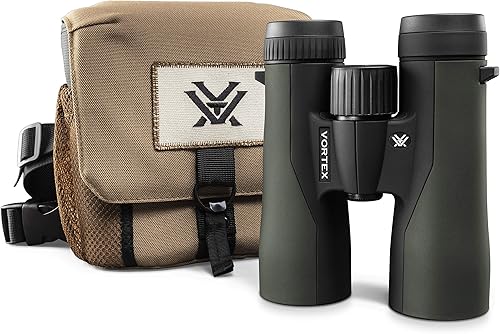
- 14 mm eye relief
- 8x magnification
- 390-foot field of view
- Tripod adaptable
An option for handheld scanning if your glasses sit close enough to allow a full view. Its short eye relief makes it a conditional choice rather than the first model to try with bulky frames.
Pros
- Moderate magnification for handheld use
- Rubber armor for grip
- GlassPak case included
Cons
- Shortest eye relief in this group
- Poor match if your glasses prevent full-field viewing
The Crossfire HD 8x42 is worth considering only after you confirm full-field visibility with your glasses. Its 14 mm eye relief is the shortest in this group, so it is a less forgiving starting point for frames that stand away from your face.
Close-fitting glasses can reduce the distance your eyes sit behind the eyepieces. They do not guarantee compatibility, but they make this a more reasonable model to consider than bulky frames would.
Once fit is settled, moderate magnification suits handheld scanning. Rubber armor provides grip, and the included GlassPak case gives you a storage and carry option.
Waterproof and fogproof construction also makes it suitable for outdoor use. Those features protect against weather-related problems inside the binoculars; they do not solve a poor match between eyepieces and glasses.
Choose it if you can comfortably see the image edges without pressing inward. Skip it if you must move your head around to recover parts of the scene, even when the center looks sharp.
For the main magnification tradeoffs, read 8x42 vs 10x42 binoculars.
5. Nikon PROSTAFF P3 8x42: the first stop for difficult glasses fit
Nikon PROSTAFF P3 8x42: Best for extra glasses clearance

- 20.2 mm eye relief
- Turn-and-slide eyecups
- 8x magnification
- 1.3 lb weight
The first model to consider when your frames hold your eyes farther from the eyepieces. It combines the longest eye relief here with moderate magnification and lower weight than the heavier alternatives.
Pros
- Longest eye relief in this group
- Turn-and-slide eyecups
- Lighter than the Nature DX and both Crossfire models
Cons
- Less reach than the higher-power choices
- Slightly narrower field than the Nature DX
The P3 8x42 is the most sensible starting point here if glasses clearance is your main concern. Its 20.2 mm eye relief is the longest in this group, giving you more room to work with behind the eyepieces.
Turn-and-slide eyecups let you adjust viewing distance rather than relying on one fixed position. Begin with them lowered while wearing glasses, then adjust only if the full image becomes easier to hold.
At 1.3 lb, it is lighter than the Nature DX and both Crossfire models. That difference matters most when you carry binoculars for hours or repeatedly lift them during a walk.
Its moderate magnification suits general birding, trail use and scanning from a stationary position. The field is slightly narrower than the Nature DX's, but a field you can see fully is more useful than extra width hidden behind dark edges.
Buy it when you want more glasses clearance and manageable handheld viewing. Skip it if your regular subjects are distant enough that you need stronger magnification and can accept the extra effort of holding it steady.
6. Nikon PROSTAFF P3 10x42: extra reach without extra weight
Nikon PROSTAFF P3 10x42: Best for distant daytime walks

- 15.7 mm eye relief
- Turn-and-slide eyecups
- 10x magnification
- 1.3 lb weight
A choice for walkers who want more reach without adding weight over the P3 8x42. Its shorter eye relief means the two Nikon versions should be judged separately for glasses fit.
Pros
- More magnification than the P3 8x42
- Same weight as the P3 8x42
- Turn-and-slide eyecups
Cons
- Much less eye relief than the P3 8x42
- More visible hand movement than with an 8x view
The P3 10x42 suits daytime walkers who want more detail on distant subjects while keeping carried weight down. It weighs the same as the P3 8x42, so choosing the stronger view does not add weight between these 2 models.
The fit changes much more than the weight. Its 15.7 mm eye relief leaves considerably less glasses clearance than the lower-power P3.
Do not assume that a comfortable fit with one Nikon version means the other will feel the same. Judge the exact magnification you plan to buy while wearing the frames you actually use outdoors.
Turn-and-slide eyecups and a central focus wheel provide viewing adjustments. Multilayer-coated lenses and a silver-alloy prism coating are also part of its optical design.
Choose it for open-country walks when a stronger handheld view helps and your glasses allow the whole image through. Skip it if you want the most forgiving eye position, or if hand movement already makes distant detail hard to hold.
How much eye relief do glasses wearers need?
Start around 17 mm of eye relief, and favor more room if your frames sit farther from your eyes. Treat that as a shopping filter, then judge whether you can actually see the image boundary.
Eye relief measures the distance behind the eyepiece where your eye receives the full view. Glasses take up part of that space, leaving less room to position your eyes correctly.
A number alone cannot describe the whole fit. Recessed eyepiece lenses, eyecup shape, your brow and the distance between your glasses and eyes all affect where you can hold the binoculars.
Your prescription strength is not a direct guide to the eye relief you need. Frame position often matters more, so compare models while wearing the glasses you expect to use outside.
Check the full circle, not just center sharpness. If the center is clear but the view is clipped around the edge, turning the focus wheel will not recover the missing field.
More eye relief gives you room, but the correct position still matters. If dark patches drift across the view, move slightly closer or farther away and check barrel spacing before rejecting the fit.
Is 8x, 10x or 12x better for your viewing?
Choose 8x for easier handheld viewing, 10x for more distant detail and 12x when you can give the image firm support. Wearing glasses does not change these tradeoffs, but it adds a separate fit requirement.
Woodland birds and nearby wildlife often favor moderate magnification. A calmer view makes it easier to follow movement and recover a subject after lowering the binoculars.
Open landscapes give stronger magnification more purpose. A bird across a lake may benefit from extra image size, provided hand movement does not hide the detail you hoped to gain.
Magnification also affects how easily you place your eyes. With a 42 mm objective, increasing power reduces the exit pupil, the small beam of light leaving each eyepiece, so careful alignment becomes more important.
Larger front lenses do not automatically mean better glasses comfort. They affect light collection and size, while eye relief describes the space behind the eyepiece.
Choose for your most common use, rather than the farthest subject you might see once. A model that feels easy during a short observation is more useful than one you avoid lifting because it takes too long to settle.
How can you check the fit before committing?
Check binoculars with your everyday outdoor glasses and repeat the process several times. A comfortable view should be easy to find again after you lower the binoculars.
Start with the eyecups lowered and the barrels aligned to your eyes. Look at a detailed, stationary subject against a plain background so you can judge both sharpness and the image boundary.
Use this short fit check:
- Find one circular image. Adjust the hinge until the 2 views merge without forcing your eyes.
- Check the edges. You should see the scene boundary without rolling your head around the eyepieces.
- Relax your grip. The view should not depend on pressing hard against your glasses.
- Look away and return. Lower the binoculars, find the subject with your eyes and raise them again.
- Stay for several minutes. Watch for frame pressure, a slipping hold or an eye position that is difficult to maintain.
Repeat with sunglasses if you use them for birding or travel. A different frame can change the fit even when both pairs carry the same prescription.
If you cannot compare models in person, check the return terms before ordering. The useful outcome is a binocular you can position comfortably, not simply the highest eye-relief number.
How do you adjust binoculars while wearing glasses?
Set eyecups and barrel spacing before focus, then use the adjustment sequence in your model's manual. Fixing the eye position first keeps a fit problem from being mistaken for a sharpness problem.
- Put on your usual glasses. Start with the eyecups in their lowered position and hold the binoculars lightly near your lenses.
- Adjust the hinge. Move the barrels until both eyes receive one round image without strain.
- Find the right distance. Move the binoculars slightly toward and away from your glasses until the field looks complete.
- Set focus and diopter as directed. Many center-focus designs use one eye for the main focus setting, then the other for the diopter adjustment.
- Cover an objective when isolating an eye. Avoid squeezing one eye shut if that makes you tense your face or shift your glasses.
- Refocus on a new distance. After the diopter is set, use the main focus control for distance changes on center-focus models.
The diopter balances focusing differences between your eyes; it is not a second control to turn every time a bird moves. Revisit it if someone else changes the setting or your usual correction changes.
Keep your glasses on when you need their correction for a clear image. Our guide to how to focus binoculars explains the focus sequence in more detail.
Which mistakes make glasses-on viewing harder?
The most common mistake is trying to solve eye position with the focus wheel. A sharp center, clipped edges and drifting dark patches can have different causes, so adjust one thing at a time.
Leaving the eyecups fully raised
Raised eyecups usually position eyes for viewing without glasses. With glasses on, they can push your eyes too far back to see the whole field.
Start low, then increase the eyecup height only if it improves the view. The goal is the correct distance, not one required setting for every wearer.
Pressing harder to recover the edges
Pressure can move your glasses, leave marks on the lenses and create an uncomfortable viewing position. If a full field requires constant force, choose a model with more usable clearance.
Rest the binoculars lightly instead. A fit that works only while you push inward will be difficult to repeat during a long walk.
Looking down through progressive lenses
Progressive glasses provide different correction through different lens areas. Looking through the lower reading area while observing a distant bird can make focus harder to judge.
Keep your head in a natural distance-viewing position and bring the binoculars to your eyes. Adjust the binocular position before making large focus changes.
Assuming waterproof means clear outside lenses
Waterproof and fogproof construction concerns the binocular's sealed interior. Rain and condensation can still collect on eyepieces, objectives and your glasses.
If the scene turns hazy, inspect those exposed surfaces before changing focus. Bringing cold equipment into warm, humid air can cause surface condensation even when the interior stays clear.
How should you carry and care for binoculars with glasses?
Use a stable carry system and clean optical surfaces so you can raise the binoculars without juggling equipment or rubbing grit across lenses. Small care habits also make it easier to tell dirty glass from poor fit.
Adjust the strap or harness so the binoculars sit where you can reach them comfortably. Keep it clear of your glasses cord if you use one, since tangled cords slow down quick viewing.
Use lens covers during dusty travel and storage. Before wiping, remove loose grit with an appropriate blower or soft lens brush, then use a clean optical cloth and suitable lens cleaner as needed.
Keep the cloth separate from sandy pockets and dirty cases. Our guide to cleaning binoculars without scratching the lenses covers a safer cleaning order.
After a damp outing, let exterior surfaces and the case dry before closing everything away. Do not dismantle the binoculars to address internal moisture.
For steadier viewing, sit down or brace your elbows against your body. Keep both feet secure, and lower the binoculars before walking over uneven ground.
Which binoculars for glasses wearers should you choose?
Choose the best binoculars for glasses wearers by eliminating poor fits before choosing reach. If you cannot see the whole field comfortably, move to a better-fitting model rather than accepting constant pressure or missing edges.
- Choose the Triumph HD 10x42 for hikes with viewing stops and an included harness.
- Choose the Crossfire HD 12x50 for distant, fairly still subjects from a supported position.
- Choose the Nature DX 8x42 for following birds and observing nearby garden wildlife.
- Choose the Crossfire HD 8x42 only when its shorter eye relief works comfortably with your frames.
- Choose the P3 8x42 when glasses clearance is the main problem you need to solve.
- Choose the P3 10x42 for more reach on walks when its closer eye position suits you.
If you are unsure, start with the P3 8x42 for fit or the Nature DX for bird tracking. For choices organized around other activities, browse our binoculars guide.
Sources
Our top 3 picks at a glance
-
1
-
2
-
3
Frequently asked questions
What eye relief should glasses wearers look for?
Start around 17 mm, and favor more room if your glasses sit well away from your eyes. That is a useful shopping filter, not a promise of fit.
Eyepiece shape, frame position and eyecup adjustment determine whether you can see the whole image without pressing against your lenses.
Should I keep my glasses on when using binoculars?
Keep your glasses on if you need their correction to see clearly, especially for astigmatism. Binocular focus changes sharpness at different distances, while the diopter balances focusing differences between eyes.
Neither adjustment replaces every prescription, so compare the view with your normal glasses before deciding to remove them.
Are 8x binoculars easier to use than 10x binoculars?
An 8x binocular generally makes hand movement less noticeable than a comparable 10x model. It is a sensible starting point for woodland birds, shared use and quick scanning.
Choose stronger magnification for distant subjects only when you can keep the image steady and still see the full field through your glasses.
How do I check binocular fit with glasses?
Lower the eyecups, adjust barrel spacing and look for one complete circular image while wearing your usual glasses. Move the binoculars slightly closer and farther away without forcing them against your lenses.
Check the edges as well as the center, then repeat after lowering and raising the binoculars several times.


