8x42 vs 10x42 Binoculars: Which Size Should You Buy? (October 2026)
For 8x42 vs 10x42 binoculars, choose 8x42 for tracking moving subjects and 10x42 for distant detail. Start with 8x42 for mixed handheld use; choose 10x42 when you mainly watch across open ground and can keep the view steady.
On this page (10 sections)
- 8x42 vs 10x42 binoculars: what changes in the view?
- Which size is easier to hold steady?
- Does 8x42 or 10x42 work better in low light?
- Which size should you choose for bird watching?
- Which size suits hiking, travel and open-country viewing?
- Which binoculars in this comparison fit your needs?
- How do you set up either size for a clear view?
- What mistakes should you avoid when buying and using binoculars?
- Common questions about choosing 8x42 or 10x42
- Make the 8x42 vs 10x42 decision around your usual outing
For 8x42 vs 10x42 binoculars, choose 8x42 for finding and following subjects, or 10x42 for distant detail. For a first pair used across woods, trails and backyards, 8x42 is the easier starting point.
Both sizes use 42 mm objective lenses, the front lenses that gather light. The first number is magnification, so 10x enlarges a subject more than 8x without increasing the front lens diameter.
Choose around your usual view: nearby movement rewards a broader scene, while distant, still subjects reward more magnification. Fit and steadiness decide how much of that advantage you can use.

8x42 vs 10x42 binoculars: what changes in the view?
10x gives you a larger subject image; 8x generally gives you more surrounding scene within the same product family. The difference affects how quickly you find a subject as well as what you see once it's centered.
At the same distance, 10x makes a subject appear 25% larger in linear dimensions than 8x. That can help separate markings on a distant bird, but it doesn't mean you'll see 25% more useful detail.
Image shake, haze and poor focus can hide the detail you're trying to gain. Higher magnification also can't see through foliage or remove the effects of heat shimmer across open ground.
For the basic terms, read what the numbers on binoculars mean. Lens diameter and magnification work together, but neither tells you everything about viewing comfort.
How field of view changes the 8x42 vs 10x42 choice
A wider field of view gives you more room around the subject. That's useful when a bird hops sideways or an animal moves toward the edge of your view.
The Crossfire HD 8x42 has a stated field width of 390 ft, compared with 325 ft for the Crossfire HD 10x42. When comparing widths across models, confirm that both use the same viewing distance.
Don't assume every 8x binocular has a wider view than every 10x binocular. Eyepiece design matters, so compare the exact models rather than choosing from magnification alone.
Which size is easier to hold steady?
8x42 is usually easier for handheld viewing, especially when you're tired or following movement. A 10x binocular enlarges the appearance of hand movement along with the subject.
Start with your feet apart, shoulders relaxed and elbows tucked toward your ribs. Hold the barrels securely without squeezing so hard that your hands become tense.
For longer views, sit down and rest your elbows on your knees or a stable support. Keep the binoculars away from surfaces that vibrate, such as an idling vehicle.
A tripod can help during long watches from one place, but it adds equipment to carry and set up. All 3 models here are tripod adaptable; you'll need a compatible mounting arrangement.
Skip 10x if you regularly lose the subject because the view moves too much. A stable, smaller image is more useful than a larger image you struggle to hold.
Does 8x42 or 10x42 work better in low light?
8x42 has an exit-pupil advantage in dim conditions, provided your eyes can use the larger light beam. The benefit varies with your pupil size, the optics and the available light.
Divide objective diameter by magnification to calculate exit pupil. For these size categories, that gives 5.25 mm for 8x42 and 4.2 mm for 10x42.
In bright daylight, your pupils may be smaller than either exit pupil, reducing the brightness difference you notice. A larger exit pupil can also make small errors in eye placement less troublesome.
Both Crossfire models have fully multi-coated lenses, which Vortex says improve light transmission. Coatings matter, but they don't turn a daytime binocular into night-vision equipment.
For dawn woodland walks, lean toward 8x42. For a distant animal against an open background, 10x may still be the more useful choice if its larger image helps you recognize details.
Which size should you choose for bird watching?
Choose 8x42 for woods and moving birds; choose 10x42 for distant birds in open habitats. Think about where you spend most of your time rather than the rare sighting you hope to make.
In trees, the hard part is often finding the bird after raising the binoculars. A broader view gives you more branches and gaps to use as reference points.
Across a lake, marsh or field, a perched bird may stay visible long enough for extra magnification to help. Support your elbows before trying to read small markings.
For nearby feeders, check close-focus distance separately before buying. Neither the magnification nor the objective size tells you how close a particular binocular can focus.
Our bird-watching size guide connects these choices to different habitats. The bird-watching binocular guide helps you compare models once you've chosen a size.
Which size suits hiking, travel and open-country viewing?
Choose 8x42 for varied trail use and 10x42 for planned distant viewing. Neither size label tells you how comfortable a binocular will be to carry for several hours.
The Crossfire HD 8x42 weighs 1.5 lb, while the Crossfire HD 10x42 weighs 1.4 lb. Lower magnification doesn't automatically mean a lighter binocular.
On a wooded trail, you'll often stop briefly to identify movement. At a scenic overlook or across open hunting terrain, you may have time to settle into a supported position.
On a moving boat, lower magnification is generally easier to manage, though neither size cancels the boat's motion. Stop walking and choose secure footing before raising binoculars on any uneven surface.
A harness can keep binoculars from swinging as much as a loose neck strap. Adjust it so you can reach the eyepieces without pulling against the straps.
Compare carrying needs in our guide to binoculars for hiking. For broader uses, start with the binoculars guide for birding, hunting and travel.
Which binoculars in this comparison fit your needs?
Choose the Triumph for glasses use, the Crossfire 10x42 for open-country viewing, or the Crossfire 8x42 for woodland scanning. The highest score doesn't override the magnification and fit that suit your routine.
Vortex Triumph HD 10x42: for glasses wearers considering 10x
The Triumph has 17 mm of eye relief, the longest among these options. Eye relief is the distance your eye can sit behind the eyepiece while still seeing the full view.
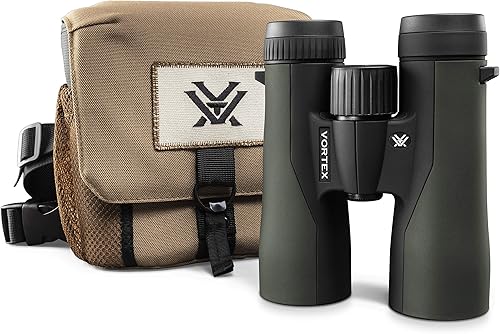
Its adjustable eyecups let you change eye position, and its diopter lets you account for differences between your eyes. The included GlassPak harness provides a carrying option for outdoor trips.
Choose it if you want distant viewing and need room for glasses between your eyes and the eyepieces. Skip it if 10x shake is your main concern, since longer eye relief won't solve that problem.
Glasses vary in shape and distance from your eyes. Check that you can see the whole circular view without pressing the binoculars against your lenses.
Vortex Crossfire HD 10x42: for distant wildlife across open ground
The Crossfire HD 10x42 suits a viewer who can take time to aim and steady the binoculars. Its right-eyepiece diopter and center focus wheel let you balance the view, then adjust focus as subject distance changes.
Choose it for watching animals across fields or birds resting beyond easy naked-eye identification range. Its rubber armor provides grip, and it supports tripod or car window mounting.
Skip it if most of your viewing involves quick movement in dense cover. Its 15 mm eye relief also makes checking the full view worthwhile if you wear glasses.
Vortex Crossfire HD 8x42: for woodland birds and mixed handheld use
The Crossfire HD 8x42 is the most suitable choice here when locating and tracking subjects comes first. Its lower magnification helps keep small hand movements from dominating the view.
Choose it for tree lines, backyard birds and walks where wildlife appears without warning. Skip it if your main goal is examining faraway subjects from a supported position, where you could use more magnification.
Its 14 mm eye relief is the shortest among these options. Glasses wearers should make full-view fit a priority before choosing it.
Vortex describes all 3 models as waterproof and fogproof. That protection supports outdoor use, but it doesn't prevent dirt, fingerprints or condensation on the outside of the lenses.
How do you set up either size for a clear view?
Set barrel spacing, eyecup height and diopter before judging the image. Poor adjustment can make a suitable binocular seem uncomfortable or leave one eye working harder than the other.
- Set the barrel spacing. Move the hinged barrels until the 2 views merge into 1 circle without dark crescents at the sides.
- Position the eyecups. Start with them lowered if you wear glasses, or raised if you don't, then adjust until the full view stays visible.
- Balance focus between your eyes. On a model with a right-side diopter, focus the left eye using the center wheel, then adjust the right eye with the diopter.
- Use the center wheel afterward. Once the diopter is set, refocus with the center wheel as you look at subjects at different distances.
Keep both eyes open during adjustment, covering one objective at a time if needed. Squinting can change how you look through the eyepiece.
For a full walkthrough, follow our guide to focusing binoculars. Our eye relief guide explains why black edges can appear even when the subject is sharp.
To find wildlife faster, look at the subject with your naked eyes and raise the binoculars without turning your head. Searching through the binoculars from the start makes a small target harder to locate.
What mistakes should you avoid when buying and using binoculars?
Avoid choosing by magnification alone or using clothing to wipe dusty lenses. A good size match can still disappoint if the binoculars fit poorly or the lenses become scratched.
Buying 10x “for later” is a common mistake when your current use is mostly nearby wildlife. Buy for the subjects and settings you'll encounter most often.
Don't confuse objective size with zoom. Both sizes here have fixed magnification, so turning the focus wheel makes the subject sharper rather than bringing it closer.
Keep lens covers on during transport, and remove loose grit with a blower or soft lens brush before wiping. Use optical cleaning supplies and light pressure for remaining marks.
Follow our binocular cleaning guide for the cleaning order. A shirt hem can carry grit even when it looks clean.
After a damp outing, let the binoculars and carrying case dry before closing everything away. Waterproof construction doesn't make storing damp gear a good habit.
Common questions about choosing 8x42 or 10x42
Choose by viewing conditions first, then check fit on the exact model. These questions help settle the remaining trade-offs.
Is 10x42 too powerful for beginners?
No, beginners can use 10x42, especially for still subjects across open ground. The greater challenge is aiming a narrower view and keeping it steady, so 8x42 is usually an easier first choice for mixed wildlife viewing.
Do 8x42 binoculars work for distant viewing?
Yes, 8x42 binoculars work at long distances, though the subject appears smaller than through 10x. There's no single useful distance limit because subject size, air conditions and the detail you need all matter.
Can 1 pair cover birding, hiking and travel?
Yes, 8x42 is a practical all-round choice when those activities involve handheld viewing and varied distances. Choose 10x42 instead if open landscapes and distant wildlife account for most of your use.
Make the 8x42 vs 10x42 decision around your usual outing
For 8x42 vs 10x42 binoculars, picture your next few outings: choose 8x42 if you'll be searching branches and following movement, or 10x42 if you'll stop and study distant subjects.
Among these models, start with the Crossfire 8x42 for woodland use, the Crossfire 10x42 for open ground, and the Triumph if glasses fit leads your priorities. Check comfort before letting the score decide.
Use our guide to choosing binoculars to finish checking fit and features. For birding, the bird-watching size guide will help you match the choice to your usual habitat.
Frequently asked questions
Are 8x42 or 10x42 binoculars better for birding?
Choose 8x42 for woodland birds and quick movement, or 10x42 for distant birds across open water or fields. Finding the bird comes before reading its markings, so a broad view often helps beginners more.
Check close-focus distance separately if you often watch birds at feeders near a window.
Do 10x42 binoculars make objects look bigger?
Yes, 10x binoculars make a subject appear 25% larger in linear dimensions than 8x binoculars at the same distance. That helps with distant markings when the view is steady.
It also enlarges the appearance of hand movement, so the extra magnification works best with a controlled grip or support.
Are 8x42 binoculars brighter than 10x42?
An 8x42 has a larger calculated exit pupil, which can help in dim light when your pupils widen enough to use it. In bright daylight, that advantage may be small.
Lens coatings, optical quality and your eyes also affect brightness, so magnification alone doesn't settle the comparison.
Can you use 10x42 binoculars without a tripod?
Yes, 10x42 binoculars are suitable for handheld viewing if you can keep the image steady. Brace your elbows, relax your shoulders and stop walking before looking through them.
For long sessions from one spot, a tripod-adaptable binocular and a compatible adapter can reduce the effort of holding the view.
Which is better for hiking, 8x42 or 10x42?
Choose 8x42 for mixed trail use and 10x42 for planned stops overlooking distant terrain. Carry weight, grip and access matter as much as magnification during a hike.
A binocular buried in your pack is slow to reach, so choose a carrying method that keeps it secure and accessible.