How to Choose Binoculars: Size, Glass and Price
To learn how to choose binoculars, start with 8x42 for general outdoor use or 10x42 for distant subjects. Then check eye relief, focus controls and carry comfort before comparing coatings and accessories.
On this page (13 sections)
- How to choose binoculars for your main activity
- What do 8x42 and 10x42 mean?
- Should you buy 8x or 10x magnification?
- How do objective size and exit pupil affect brightness?
- Which glass, coatings and field-of-view figures matter?
- How should glasses, eye relief and handling affect your choice?
- Which outdoor features are worth paying for?
- How much should you spend on binoculars?
- Which binocular size should birders start with?
- How do you set up binoculars for a clear view?
- What care habits help protect binocular lenses?
- Which buying mistakes should you avoid?
- How to choose binoculars and make the final decision
To understand how to choose binoculars, start with your main activity: pick 8x for easier handheld viewing or consider 10x for distant subjects in open areas. Then choose a lens size you can carry comfortably and check that the eyecups, eye relief and focus controls work for you.
An 8x42 is a practical first pair for mixed outdoor use. Buying more magnification before checking fit can leave you with a larger image that's harder to use.
For help decoding sizes, read what the numbers on binoculars mean. Our best binoculars for different uses guide helps you compare options once you've narrowed your needs.
How to choose binoculars for your main activity
Choose around the viewing you'll do most often, rather than an occasional trip. A garden birder needs to find moving subjects quickly, while someone watching wildlife across open ground may value a larger image.
Think about the whole outing, including the walk to your viewing spot. Binoculars that stay in your bag because they're awkward to carry won't help you spot much.
| Main use | Useful starting point | Main buying priority |
|---|---|---|
| Birds in woods or gardens | 8x | Finding and following subjects |
| Distant wildlife across open ground | 10x | Detail with enough handheld steadiness |
| Hiking and travel | A manageable full-size or compact pair | Carry comfort and access |
| Sports and events | 8x or 10x, depending on distance | Keeping action within the view |
| Dawn and dusk wildlife | Moderate power with larger objectives | Light gathering and stable support |
| Mixed outdoor use | 8x42 | A balance of handling and light gathering |
If you mainly walk in bright daylight, consider smaller binoculars alongside full-size models. For long sessions near a vehicle or viewing platform, you can give more weight to viewing comfort than pack space.
What do 8x42 and 10x42 mean?
The first number is magnification, and the second is the diameter of each front objective lens in millimeters. An 8x42 makes a subject appear about as large as it would from one-eighth the distance, using 42 mm objectives.
A 10x42 has the same front lens diameter but higher magnification. It enlarges distant subjects more, while also making movement from your hands more visible.
The objective lenses gather light, but their size doesn't tell you the whole story about brightness. Magnification, coatings, optical design and how well your eyes line up with the eyepieces also matter.
For a direct comparison, see 8x42 vs 10x42 binoculars. If birds are your main interest, our guide to choosing binocular size for bird watching explains the habitat trade-offs.
Should you buy 8x or 10x magnification?
Choose 8x as your default for handheld use, especially for moving subjects or long viewing sessions. Move to 10x when distant detail matters enough to accept more visible shake.
An 8x model often has a wider field of view than a comparable 10x model. That extra space helps when a bird moves between branches or an animal crosses your path.
Higher power is useful across fields, water and open hillsides. It becomes less helpful when the image moves so much that you can't study the detail you've enlarged.
Try holding each option for a minute, rather than taking one quick look. Fatigue and an awkward grip can become clear only after the first few seconds.
You can improve steadiness by bringing your elbows toward your body or resting them on a stable surface. If you still struggle, lower magnification is a better first step than trying to compensate with more effort.
How do objective size and exit pupil affect brightness?
Choose objective size for your light conditions and carrying limits. Larger lenses can gather more light, but bigger binoculars usually take up more space and can weigh more.
For mostly daytime use, a smaller pair may be worth the trade-off. For wildlife at dawn or dusk, full-size objectives give you more scope to work in fading light.
Exit pupil helps explain the relationship between lens size and power. Divide objective diameter by magnification: 8x42 produces a 5.25 mm exit pupil, while 10x42 produces 4.2 mm.
A larger exit pupil can make eye placement more forgiving and can help in dim light when your pupils widen. It doesn't guarantee a brighter view in every situation, especially in bright daylight.
Choose the binocular you can carry through the whole outing. A large pair left at home gathers no useful light for you.
Which glass, coatings and field-of-view figures matter?
Prioritize useful coating details and comparable field-of-view figures over labels such as HD. A name alone doesn't describe how much of the image stays sharp or how comfortable it is to view.
Lens coatings reduce reflections at glass surfaces, helping more light pass through the binoculars. Prism coatings serve a different role by improving reflection within the optical system.
Protective exterior coatings have another purpose: helping shield exposed lenses from marks and dirt. Don't confuse that protection with an improvement in magnification or field of view.
Compare linear field of view only at the same stated distance. A figure in feet at 1,000 yards can't be compared directly with an angle in degrees without converting it.
Look through the center first, then move your attention toward the edges. Check whether details remain useful across the area where you'll follow subjects, rather than judging the center alone.
For nearby birds, butterflies or garden use, also check close-focus distance before buying. Binoculars that won't focus at your usual viewing distance are a poor match, regardless of their other features.
How should glasses, eye relief and handling affect your choice?
Choose a full, comfortable view with your usual eyewear before paying for optical upgrades. If you can't position your eyes correctly, you may lose part of the field of view.
Eye relief is the distance between the eyepiece and your eye at which you can see the full image. Glasses increase that gap, so longer eye relief usually gives you more room.
Around 16 mm or more is a useful starting point for glasses wearers, but the shape of your glasses and eyecups matters too. Our explanation of eye relief on binoculars covers the fit in more detail.
Check the hinge adjustment as well as the eyecups. You should be able to bring the 2 views together into one circle without squeezing the binoculars into an awkward position.
Reach for the focus wheel while holding the barrels normally. If you'll use gloves, check that you can turn it without changing your grip.
Carry comfort deserves the same attention. A harness spreads the load across your shoulders and torso, while a neck strap is simpler for short outings.
Which outdoor features are worth paying for?
For regular outdoor use, prioritize waterproofing, internal fog protection and a secure grip. These features help when weather changes or the binoculars move between warm and cold conditions.
Internal fog protection doesn't stop moisture from condensing on the outside of a cold lens. Let the binoculars adjust to a warmer environment before wiping repeatedly at a fogged surface.
Rubber armor helps you hold the body, but it doesn't make lenses safe from drops. Use the strap or harness before leaning over railings or taking the binoculars out above hard ground.
Tripod adaptability matters most for long, fixed viewing sessions. Check the adapter and mount requirements separately, since a compatible binocular doesn't necessarily include every part you need.
Read whether waterproof and fogproof binoculars are worth it for your outings. Keep waterproof binoculars out of deliberate underwater use unless their instructions specifically allow it.
How much should you spend on binoculars?
Spend enough to get the right fit, useful optics and protection for your routine. A more expensive pair is worthwhile when it solves a problem you actually have.
Compare similar sizes first so you can see what the extra money buys. Useful differences may include more suitable eye relief, additional coatings or a carrying system you'll use every day.
Include accessories in your budget. A tripod setup may need an adapter, and a comfortable harness can matter more on a long walk than a feature you rarely use.
How to choose binoculars within a budget
Choose your size and comfort requirements first, then compare the remaining features. This prevents a discount or a long feature list from steering you toward the wrong pair.
The 4 models below show different buying priorities. AtticAlmanac's recommendations here focus on their features and suitability for specific uses.
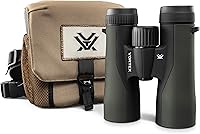
Vortex Triumph HD 10x42: for distant viewing with a harness
Choose the Triumph if you want higher power for open-country wildlife and a carrying setup included from the start. Its adjustable eyecups and diopter let you set the viewing position and account for differences between your eyes.
It pairs fully multi-coated lenses with a rubber-armored polycarbonate body. Waterproof and fogproof construction fits outdoor trips where rain and temperature changes are likely.
Skip it if most of your viewing involves nearby, fast-moving birds or if you already find higher power difficult to hold steady. Its 17 mm eye relief is worth checking with your own glasses before deciding.
Vortex Crossfire HD 8x42: for general outdoor viewing
Choose the Crossfire if you want moderate power for mixed outdoor use, with a carrying harness included. It's a sensible candidate for walks that combine scanning, short stops and longer looks.
The roof-prism design, center focus and tripod adaptability cover both handheld viewing and a supported setup. Nitrogen purging and O-ring seals provide water and fog protection.
Glasses wearers should approach its 14 mm eye relief carefully. Skip it if you can't see the full field with your normal eyewear, and put the Nikon below on your shortlist instead.
Nikon PROSTAFF P3 8x42: for glasses wearers
Choose the Nikon if viewing with glasses is your first concern. Its eye relief gives you more room between your eyes and the eyepieces than the other models discussed here.
Multilayer-coated lenses and silver-alloy prism coatings address light transmission, while the rubber-armored, fiberglass-reinforced polycarbonate body provides grip. It includes a case and neck strap for carrying.
Skip it if your main goal is stronger magnification for distant wildlife. Its waterproof design also isn't permission to use it underwater.
Vortex Diamondback HD 8x42: for frequent outdoor use
Choose the Diamondback if you want moderate power with added lens protection for regular outings. It also combines fully multi-coated lenses with dielectric prism coatings.
Its field of view is 393 feet at 1,000 yards, useful for scanning a scene before settling on a subject. Adjustable eyecups, a right-eye diopter and an included GlassPak harness support longer outdoor sessions.
Skip it if occasional viewing is your only need and the added coatings don't address a priority. Glasses wearers should still check fit rather than assume its features guarantee comfort.
Which binocular size should birders start with?
Start with 8x42 for woods, gardens and mixed habitats, then consider higher power for regular long-distance viewing. Finding a bird quickly often matters more than making it look slightly larger.
Practice locating the bird with your unaided eyes before raising the binoculars. Keep your gaze on its position and bring the eyepieces to your face, rather than looking down first.
Birders who spend most of their time on shorelines or open ground may favor more power. A steady image and usable field of view remain essential for following movement.
Read how to choose binoculars for bird watching for habitat-specific advice. Then compare the best binoculars for bird watching within your chosen size.
How do you set up binoculars for a clear view?
Set barrel spacing, eyecup height and the diopter before judging image quality. Poor adjustment can make a suitable pair seem uncomfortable or hard to focus.
- Attach the strap or harness securely.
- Adjust the hinge until the views merge into one circle.
- Lower the eyecups for glasses, or raise them as needed without glasses.
- Use a detailed stationary subject at a comfortable distance.
- Follow the model's instructions to set focus for each eye and adjust the diopter.
- Use the center wheel for normal distance changes afterward.
Our guide to focusing binoculars the right way walks through the process. If someone else borrows your binoculars, check the settings again before your next outing.
Never point binoculars at the sun. Magnified sunlight can cause severe eye injury.
What care habits help protect binocular lenses?
Remove loose grit before wiping, and keep the caps on during storage. Rubbing dust across a lens can scratch its surface or coatings.
Use an air blower or soft lens brush first, then a clean lens cloth and suitable optical cleaner as directed. Avoid shirt hems, tissues and household glass cleaners.
Let wet binoculars dry before closing them inside a case. Store them somewhere dry, away from prolonged heat, and keep the cleaning cloth free of sand and grit.
For the full process, follow our guide to cleaning binoculars without scratching the lenses.
Which buying mistakes should you avoid?
Avoid choosing on magnification alone or accepting poor fit because a model has more features. Both mistakes can make everyday viewing harder.
- Buying excess power: a larger moving image can reveal less useful detail than a smaller steady one.
- Ignoring close focus: garden subjects may sit nearer than your binoculars can focus.
- Comparing mismatched figures: field-of-view numbers need the same distance or units.
- Skipping eyewear fit: long eye relief helps, but the full view is the final check.
- Forgetting carry time: consider the walk, not just the minute spent looking through them.
- Expecting waterproofing to replace care: dry the body and protect exposed lenses.
Before ordering, confirm that the return terms allow you to assess fit. Check the controls, view and carrying comfort promptly while keeping the binoculars protected.
How to choose binoculars and make the final decision
Make your final choice by solving your main viewing need first. Use these decision rules to choose between the models rather than counting features.
Pick the Triumph for distant outdoor subjects when you want higher power and an included harness. Pick the Crossfire for general viewing if its shorter eye relief works for you.
Choose the Nikon when glasses compatibility leads your priorities. Choose the Diamondback when regular outdoor use makes its protective and optical coatings useful additions.
If 2 models still seem equally suitable, favor the one you can focus easily, hold steadily and carry comfortably. Use our binoculars guide for birding, hunting and travel to match that shortlist to your main activity.
Frequently asked questions
What magnification is best for general binocular use?
Start with 8x magnification for general outdoor viewing because it makes hand movement less noticeable than 10x. It also often gives you more room to find moving subjects.
Choose 10x for distant wildlife in open areas if you can keep the view steady during normal use.
Are 8x42 binoculars better than 10x42?
Choose 8x42 for easier handheld viewing and 10x42 for a larger view of distant subjects. With the same objective size, 8x42 also produces a larger exit pupil, which can help in dim conditions.
Your main activity and ability to hold the image steady should decide the choice.
What does objective lens size mean?
Objective lens size is the diameter of each front lens in millimeters, shown by the second number in 8x42 or 10x42. Larger objectives can gather more light, but they generally add bulk.
Choose a size that fits both your usual light conditions and your willingness to carry it.
Do glasses wearers need long eye relief?
Glasses wearers usually benefit from longer eye relief because their lenses hold their eyes farther from the eyepieces. Around 16 mm or more is a useful starting point, though fit varies.
Lower the eyecups and check that you can see the full circular view with your usual glasses.