Vortex Crossfire HD vs Diamondback HD: Is It Worth It? (October 2026)
In the Vortex Crossfire vs Diamondback comparison, choose the Diamondback HD for glasses and frequent outdoor use, thanks to longer eye relief and added lens coatings. Choose the Crossfire HD for casual viewing if it fits comfortably and you don't need those extras.
On this page (11 sections)
- Vortex Crossfire vs Diamondback: what changes?
- Does the Diamondback's longer eye relief matter?
- How much difference does the field of view make?
- Do the Diamondback's lens coatings justify choosing it?
- Which binoculars make more sense for birding?
- What do you get with each model?
- How should you set up your binoculars?
- How should you care for them in rain and dust?
- Is the Vortex Triumph HD 10x42 a better alternative?
- Which buying mistakes should you avoid?
- Which Vortex binocular should you choose?
The Vortex Diamondback HD is the stronger choice for glasses wearers, while the Crossfire HD suits casual wildlife watchers who get a comfortable fit. In this Vortex Crossfire vs Diamondback comparison, the buying decision comes down to eye position and added coatings.
Both use the same 8x42 format, so moving to the Diamondback won't make a distant bird look larger. Choose it for features you'll use, rather than expecting a change in magnification.

Vortex Crossfire vs Diamondback: what changes?
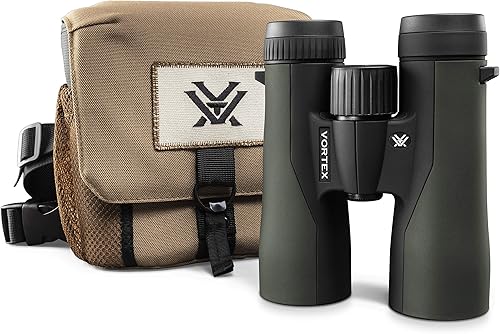
The Diamondback adds longer eye relief and extra lens coatings. The Crossfire covers the core needs of a general outdoor binocular, including fully multi-coated lenses, rubber armor and weather protection.
| Feature | Vortex Crossfire HD 8x42 | Vortex Diamondback HD 8x42 |
|---|---|---|
| Magnification and objective lenses | 8x42 | 8x42 |
| Eye relief | 14mm | 17mm |
| Lens coatings | Fully multi-coated | Fully multi-coated, dielectric, Armortek |
| Purging | Nitrogen | Argon |
| Included carry gear | GlassPak case and harness, neck strap | GlassPak case and harness, neck strap |
| Tripod adaptable | Yes | Yes |
The shared format makes these sensible choices for backyard birds, trail stops and general wildlife viewing. Neither requires you to accept higher magnification just to gain the Diamondback's added features.
Crossfire vs Diamondback: which extras will you use?
Choose the Diamondback when room behind the eyepieces or exterior lens protection solves a real need. If you wear glasses throughout a walk or regularly carry binoculars through dusty places, those additions have a clear purpose.
Choose the Crossfire when your use is occasional and the view fits your eyes comfortably. A feature you rarely need shouldn't outweigh a binocular that feels easy to position, focus and carry.
Does the Diamondback's longer eye relief matter?
The Diamondback gives your eyes more room behind the eyepieces, which makes it the better starting point for glasses. Eye relief describes where your eyes need to sit to see the full image.
Glasses hold your eyes farther from the eyepieces. If the usable distance is too short, you may see a reduced circle instead of the full field, even though the center looks sharp.
The Diamondback's twist-up eyecups let you adjust that position. Start with them lowered when wearing glasses, then raise them only if doing so improves the view without cutting off the edges.
Without glasses, begin with the eyecups raised and adjust as needed. Dark crescents or blackouts can come from poor eye placement, so correct the position before deciding the optics don't suit you.
During a fit check, look at something broad, such as a tree canopy. You should see a single circular image without pressing hard against your glasses or shifting your head to find each edge.
Our guide to eye relief on binoculars explains the fit in more detail. If neither model gives you a comfortable full view, compare our binoculars for glasses wearers before choosing.
How much difference does the field of view make?
Don't choose between these models based on an assumed field-width advantage. The Diamondback covers 393 ft at 1,000 yards, while the Crossfire's 390 ft figure lacks a reference distance.
A field width only makes sense alongside the distance where it's measured. These figures don't support calling one view 3 ft wider than the other.
In use, a broad view helps you find a bird after lifting the binoculars and follow it between branches. Comfortable eye placement matters too, because you can't use the whole view if the edges are cut off.
For a moving subject, locate it with your bare eyes first. Keep looking at that spot as you raise the binoculars, rather than searching through the eyepieces from an unrelated starting point.
If the format itself is unfamiliar, read what the numbers on binoculars mean. Our 8x42 vs 10x42 binoculars guide explains when changing magnification makes more sense than changing models.
Do the Diamondback's lens coatings justify choosing it?
The Diamondback's extra coatings give frequent outdoor users a practical reason to choose it. Separate their jobs: dielectric coating concerns the image, while Armortek protects the exterior lens surfaces.
Vortex says the dielectric coating helps produce bright, clear, color-accurate images. Vortex describes Armortek as protection against scratches, oil and dirt.
Exterior protection is useful if your binoculars often meet dusty trails, fingerprints or damp vegetation. It doesn't replace lens covers, and it isn't a reason to rub grit across the glass.
Both models already have multiple anti-reflective coatings on their air-to-glass surfaces. Don't treat the Crossfire as an uncoated option or assume a coating name proves a fixed improvement in every scene.
If your usual outing is a short look at the backyard feeder, added coatings may have little influence on your decision. For regular field use, the Diamondback gives those features more chances to earn their place.
Read are Vortex binoculars good? for broader brand context. Our Vortex Diamondback HD 8x42 review covers this model in more detail.
Which binoculars make more sense for birding?
Choose by viewing comfort first, then by how often you'll carry them. The Diamondback suits birders who need extra space for glasses, while the Crossfire suits occasional watchers whose fit needs are already met.
For woodland birding, finding a bird quickly can matter more than making it look larger. An easy handheld view helps when you switch between nearby branches and birds farther across a clearing.
Backyard use gives you time to rest your elbows on a stable surface and adjust focus. If you mainly watch a feeder from one place, the Crossfire's core features may cover the job without needing the Diamondback's additions.
Long walks put more emphasis on carrying position. Use the included harness to keep the binoculars reachable, and adjust it so they don't swing into your chest whenever you bend forward.
Skip both models if your main goal is to study tiny details on very distant, stationary birds and you expect more magnification. Changing from one of these models to the other won't solve that need.
For help choosing a format, see what size binoculars you need for bird watching. Our best binoculars for bird watching guide gives you alternatives if neither fits your routine.
What do you get with each model?
Both include the carry gear and lens covers needed for ordinary outings. Each comes with a GlassPak case and harness, neck strap, tethered objective covers, rainguard eyepiece cover and lens cloth.
You don't need to choose the Diamondback just to get a harness. Before buying accessories, unpack the included gear and decide how you prefer to carry the binoculars.
Both models can be used with a tripod or car window mount. Tripod adaptability doesn't mean a tripod is included, so check the adapter and mount requirements before planning a fixed viewing setup.
Vortex backs both with its transferable, unlimited lifetime VIP Warranty for repair or replacement of damaged or defective items. It excludes loss, theft, deliberate damage and cosmetic damage that doesn't affect performance.
The shared warranty removes one reason to favor either model. Secure the strap properly, because a repair promise doesn't help you recover binoculars left beside a trail.
How should you set up your binoculars?
Set barrel spacing and focus before judging the view. A binocular that isn't aligned with your eyes can feel uncomfortable even when its optical features suit your needs.
First, look through both eyepieces and move the barrels closer together or farther apart. Stop when the two circles become one round image without overlapping shadows.
Next, adjust the eyecup position for your eyes and glasses. Hold the binoculars lightly against your brow or glasses rather than pushing hard to force a full view.
The Diamondback's right-eyepiece diopter compensates for differences between your eyes. Aim at a detailed, stationary object and use the center wheel to focus the left eye while covering the right objective.
Then cover the left objective and adjust the diopter for the right eye without moving the center wheel. Afterward, use the center wheel for normal distance changes and leave the diopter alone unless your needs change.
For any model, follow its adjustment instructions rather than turning controls at random. Our guide to focusing binoculars correctly walks through the process.
During use, tuck your elbows toward your body and support the barrels with both hands. Resting against a tree or railing can steady the view without changing binoculars.
How should you care for them in rain and dust?
Keep grit off the lenses and dry the binoculars before storage. Vortex describes both models as waterproof and fogproof, but those protections don't remove the need for routine care.
O-ring seals help keep moisture out, and gas purging addresses internal fogging. Neither feature keeps rain off the outer lenses or prevents every film of condensation on exposed glass.
Keep the eyepiece cover in place while walking through rain. After an outing, wipe moisture from the body and let the binoculars dry before closing them inside the case.
For dusty lenses, remove loose particles before wiping. Rubbing a dry cloth over grit can drag it across the surface, including on lenses with protective coatings.
Use lens-safe cleaning materials and keep the cloth clean. A cloth stored loose in a dusty pocket can carry the same dirt you're trying to remove.
Our guide to cleaning binoculars without scratching the lenses covers the sequence. Don't take either model's weather protection as permission to submerge it without a stated depth and duration.
Is the Vortex Triumph HD 10x42 a better alternative?
Consider the Triumph when you want a larger image of distant subjects, rather than the Diamondback's additions within the same format. It changes the magnification choice and brings a different handling tradeoff.
At higher magnification, your hand movement becomes more visible along with the subject. That makes a braced position useful for watching an animal standing across open ground.
Skip this alternative if you already struggle to keep binoculars steady or mostly follow nearby birds between branches. More magnification won't fix shaky handling or poor focus.
Confirm the Triumph's magnification before ordering because its 10x42 model name conflicts with Vortex's feature text describing 1x. Its conflicting viewing-angle figures also don't support a useful field-of-view comparison here.
The Triumph has a polycarbonate chassis with rubber armor, and Vortex describes it as waterproof, fogproof and shockproof. Those features make it worth considering for outdoor use, but they don't settle the magnification choice.
Read our Vortex Triumph HD 10x42 review for more detail. If you decide on that format, compare it with the Crossfire in our 10x42 comparison.
Which buying mistakes should you avoid?
Avoid choosing by model rank before checking fit and purpose. A higher score doesn't make a different magnification or an uncomfortable eye position right for your use.
Don't expect the Diamondback to bring subjects closer than the Crossfire. Their matching magnification means the reasons to move up are the added features and your viewing comfort.
Don't judge low-light usefulness from the HD label alone. That label doesn't establish how much detail you'll identify in a shaded wood or after sunset.
Don't buy either as a pocket binocular without considering how you'll carry it. Decide whether the harness, neck strap or a place in your bag fits your outings.
Finally, don't mistake poor setup for a poor match. Correct barrel spacing, eyecup position and focus first, then decide whether the binoculars let you see comfortably.
Which Vortex binocular should you choose?
For Vortex Crossfire vs Diamondback, choose the Diamondback if glasses fit or added exterior lens protection is a priority. Choose the Crossfire if it gives you a comfortable full view and your usual outings don't call for those extras.
Skip the Crossfire if its shorter eye relief cuts off your view with glasses. Skip the Diamondback if you're moving up mainly to get a larger image, because it keeps the Crossfire's magnification.
Consider the Triumph only after deciding that distant subjects justify the steadier hold a higher-power binocular needs. For options beyond these models, use our binoculars guide for birding, hunting and travel to match the format to your main activity.
Frequently asked questions
Is the Diamondback HD worth choosing over the Crossfire HD?
Choose the Diamondback HD if you wear glasses or want added exterior lens protection for frequent outdoor use. Its longer eye relief and extra coatings give you specific reasons to move up.
Choose the Crossfire HD if it fits comfortably and those additions won't change how you use your binoculars.
Which Vortex 8x42 has the wider field of view?
The available measurements don't establish a reliable winner. The Diamondback HD covers 393 ft at 1,000 yards, while the Crossfire HD's 390 ft figure lacks a reference distance.
Compare field widths only at matching distances, and don't base your choice on an assumed 3 ft difference.
Which model is better for glasses?
Start with the Diamondback HD because its 17mm eye relief gives you more space than the Crossfire HD's 14mm. Lower its twist-up eyecups and check the full circular view while wearing your usual glasses.
Frame shape, lens position and your face still affect whether the fit works.
Are the Crossfire HD and Diamondback HD waterproof?
Vortex describes both as waterproof and fogproof, with o-ring seals and gas purging. These features suit outdoor use in changing weather, but they don't establish a safe immersion depth or duration.
Keep the covers on between uses and dry the binoculars before putting them away.
Should I choose an 8x42 or 10x42?
Choose 8x42 for easier handheld viewing, especially when following moving birds or scanning from an unsteady position. Consider 10x42 for a larger image of distant subjects when you can brace your arms or use support.
Higher magnification also enlarges visible shake, so more power isn't always more useful.