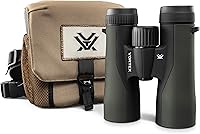
Vortex Diamondback HD 8x42 Review: Worth It? (October 2026)
The Vortex Diamondback 8x42 is a strong choice for general birding thanks to its broad view, adjustable eyecups and included GlassPak harness. Choose the Nikon PROSTAFF P3 instead if you need more eye relief, or the Celestron Nature DX for its 6.5 ft close focus.
On this page (9 sections)
- What does the Vortex Diamondback 8x42 offer?
- How does it compare with similar 8x42 binoculars?
- Will the Diamondback HD work with glasses?
- How should you set the focus and diopter?
- How can you find birds and hold the view steady?
- How does it handle rain, fog and dirty lenses?
- What comes with the Diamondback HD?
- Which buying mistakes should you avoid?
- Should you buy the Vortex Diamondback 8x42?
The Vortex Diamondback 8x42 is a strong all-around birding choice for people who want an easy-to-follow view, weather protection and a supplied carry harness. Its main appeal is the combination of useful optics, adjustable fit and practical outdoor accessories.
Choose it for woodland walks, wildlife watching and mixed outdoor trips where you move between scanning and studying a subject. If glasses comfort or nearby subjects matter most, one of the alternatives below may fit your needs better.
Compare the Nikon PROSTAFF P3 8x42 review for more eye relief, or the Vortex Crossfire HD vs Diamondback HD comparison for a closer look at the two Vortex ranges.
What does the Vortex Diamondback 8x42 offer?
The Diamondback HD combines a broad viewing field with useful lens coatings and outdoor protection. It suits buyers who want one full-size binocular for several activities rather than a specialist model for distant detail.
Vortex Diamondback HD 8x42: Best for all-around birding

- 8x magnification
- 42 mm objective lenses
- 393 ft field of view at 1,000 yd
- 17 mm eye relief
- Waterproof and fogproof
A strong general birding choice with a broad view and an included GlassPak harness. Twist-up eyecups and a right-side diopter help you set the view for your eyes.
Pros
- Broad field for locating moving birds
- Armortek exterior lens coating
- Waterproof and fogproof construction
- GlassPak case and harness included
Cons
- Less eye relief than the Nikon PROSTAFF P3
- Full-size format takes more bag space than compact binoculars
Its fully multi-coated lenses reduce reflections at air-to-glass surfaces, while a dielectric coating supports light transmission through the prism system. Vortex says its selected glass elements help reduce color fringing and improve resolution and color fidelity.
Armortek protects the outer lenses against scratches, oil and dirt. That is useful around dusty trails and frequent handling, but it does not replace lens caps or careful cleaning.
The main reason to choose this model is the whole package. You get viewing adjustments, a carry system and protected optics without needing to build a separate accessory kit for basic outings.
Is the Vortex Diamondback 8x42 the right size for birding?
The 8x42 format suits general birding because it balances useful reach with a view that is easier to hold steady than higher magnification. The first number means objects appear 8 times larger; the second gives the front lens diameter in millimeters.
More power also magnifies hand movement and usually makes finding a subject harder. For a bird that keeps hopping between branches, getting it into view quickly can matter more than making it appear larger.
Full-size binoculars also need space in a day bag. If you want something that stays in a jacket pocket during errands, consider a compact format before choosing any model in this comparison.
Read what the numbers on binoculars mean for the basics, or use our 8x42 vs 10x42 binoculars guide if distant wildlife is your main interest.
How does it compare with similar 8x42 binoculars?
The Diamondback is the general birding pick, while the Nikon favors glasses clearance and the Celestron favors nearby nature. The Crossfire gives outdoor beginners a similar Vortex package, provided its shorter eye relief fits their eyes.
| Model | Field of view | Eye relief | Main reason to consider it |
|---|---|---|---|
| Vortex Diamondback HD 8x42 | 393 ft at 1,000 yd | 17 mm | General birding with a supplied harness |
| Vortex Crossfire HD 8x42 | 390 ft | 14 mm | Similar outdoor format and carry package |
| Celestron Nature DX 8x42 | 388 ft | 17.5 mm | Nearby subjects and backyard nature |
| Nikon PROSTAFF P3 8x42 | 377 ft at 1,000 yd | 20.2 mm | More clearance for glasses |
Do not let small differences in field-of-view figures decide the whole purchase. A full, comfortable image is more useful than a wider stated field that you cannot see because your eyes sit too far from the eyepieces.
Who should choose the Crossfire HD?
Choose the Crossfire for a straightforward outdoor binocular with a supplied harness, especially if you view without glasses. It has fully multi-coated lenses, rubber armor and tripod adaptability.
Skip it if your glasses already make binocular viewing difficult. It has the least eye relief here, so it is the first model to rule out when you cannot see the full image.
The Crossfire also uses nitrogen purging rather than the Diamondback's argon. Both provide internal fog protection, so the gas name alone is a weak reason to choose one over the other.
Who should choose the Nature DX?
Choose the Nature DX for butterflies, flowers and nearby feeder birds. Its 6.5 ft close focus gives you a clear reason to favor it when your subjects are just beyond arm's reach.
It combines fully multi-coated lenses with phase-coated BaK-4 prisms. Its rubber-armored polycarbonate housing and nitrogen purging also suit outdoor nature watching.
Skip it if your main goal is extra space behind the eyepieces with glasses. If you plan extended viewing from a tripod, allow for a separate adapter, which is not included.
Who should choose the PROSTAFF P3?
Choose the PROSTAFF P3 when glasses clearance is your first concern. It provides the most eye relief in this group, plus turn-and-slide eyecups for setting your viewing distance.
Its fiberglass-reinforced polycarbonate body has rubber armor, and its optics use multilayer lens coatings and a silver-alloy prism coating. A central focus wheel handles distance changes.
Skip it if you already get a comfortable full view through the Diamondback and want the broader field for following movement. More eye relief is valuable when you need it, but it does not automatically make the image sharper.
For other Vortex options, see our Vortex Crossfire HD vs Triumph HD comparison. Our guide to whether Vortex binoculars are good adds broader brand context.
Will the Diamondback HD work with glasses?
The Diamondback can work with glasses, but seeing the full field is the deciding check. Eye relief is the distance your eye can sit behind the eyepiece while still seeing the whole image.
Start with the eyecups lowered if you wear glasses. Without glasses, raise them until they support a comfortable viewing position without cutting off the edges.
Next, move the barrels closer together or farther apart until the 2 images merge into one circle. Dark crescents or sudden blackouts can come from incorrect barrel spacing or eye position, so fix those before blaming the optics.
Keep glasses on if you need their correction to see clearly, especially for astigmatism. A diopter adjusts focus differences between eyes; it does not replace every kind of prescription correction.
Try the binocular with the glasses you actually wear outdoors. Our guide to binocular eye relief explains how to judge fit without relying on a number alone.
How should you set the focus and diopter?
Set the right-side diopter once for your eyes, then use the center wheel as subjects move closer or farther away. Repeatedly turning both controls makes it harder to keep a consistent view.
Choose a still subject with clear detail, such as lettering or tree bark. Avoid leaves moving in the wind, since movement makes small focus changes harder to judge.
- Adjust barrel spacing and eyecups until you see one full circle.
- Cover the right front lens without pressing on the glass.
- Use the center wheel to sharpen the view through the left barrel.
- Cover the left front lens and uncover the right.
- Leave the center wheel alone and adjust the right diopter for clarity.
- Uncover both lenses and use only the center wheel for distance changes.
Check the setting again if someone else uses the binocular. A shared pair needs a quick fit and focus reset when it changes hands.
Follow our guide on how to focus binoculars if one side stays soft. Also check for fingerprints before making repeated adjustments.
How can you find birds and hold the view steady?
Find the subject with your unaided eyes first, then raise the binocular without shifting your gaze. Starting with the binocular already at your face makes a small bird harder to locate.
Use a nearby branch, trunk or roof edge as a reference point. For moving birds, begin slightly ahead of their path rather than searching behind them.
Hold both barrels and keep your elbows near your body. Leaning against a tree or resting your elbows on a solid surface can reduce shake during longer looks.
The Diamondback is tripod adaptable and can work with a compatible car window mount. Support is most useful for prolonged viewing from one spot, though it adds equipment to carry.
Never look at the sun through binoculars. Keep that rule in mind when scanning treetops or following birds near sunrise and sunset.
How does it handle rain, fog and dirty lenses?
The Diamondback's O-ring seals and argon purging protect against water entry and internal fogging. Rubber armor helps your grip, while Vortex describes the body as built to withstand recoil and impact.
Internal fog protection does not prevent moisture from forming on the outside of cold lenses when you enter warm, humid air. Let the binocular adjust to the temperature rather than repeatedly wiping condensation as it returns.
Keep the eyepiece cover in place during rain when you are not viewing. After an outing, dry the body and let the case dry before closing everything away.
Remove loose grit with a blower or soft lens brush before using a cloth. Rubbing a dusty lens with a shirt can drag particles across the coating, even when the lens has extra surface protection.
For stubborn marks, use a cleaner suitable for coated optics and follow Vortex's care instructions. Our binocular cleaning guide covers the order of cleaning steps.
Do not assume waterproof construction makes deliberate soaking or underwater viewing sensible. Read our guide to waterproof and fogproof binoculars for the difference between sealing and fog protection.
What comes with the Diamondback HD?
The Diamondback includes a GlassPak case and harness, plus a comfort neck strap, tethered objective covers, an eyepiece rainguard and a lens cloth. The harness gives you a chest-carry option for longer walks.
Adjust it before your first outing so the binocular stays close to your body but still reaches your eyes freely. Loose carry gear can let it swing into branches or other equipment.
Vortex backs the binocular with its transferable VIP Warranty, promising lifetime repair or replacement for damage or defects. It excludes loss, theft, deliberate damage and cosmetic damage that does not affect performance.
Read Vortex's VIP Warranty terms for the full conditions. Keep the binocular secured during travel, since a repair promise cannot replace a lost pair.
Which buying mistakes should you avoid?
Choose for viewing comfort and your usual subjects, rather than the largest number or longest feature list. A good fit matters every time you raise the binocular.
- Buying more magnification by default: Higher power increases visible shake and can make moving wildlife harder to find.
- Judging low-light use by lens size alone: Coatings, steadiness and your eyes also affect the usable view; binoculars still need available light.
- Treating every soft image as an optical fault: Check eye spacing, diopter adjustment, focus and lens cleanliness first.
- Choosing by a tiny field difference: Give more weight to seeing the full image comfortably.
- Forgetting the carry routine: Decide whether you will use the harness, neck strap or bag before a long walk.
If your main activity still is not clear, start with our binoculars guide for birding, hunting and travel. It helps match the format to how you will actually use it.
Should you buy the Vortex Diamondback 8x42?
Buy the Vortex Diamondback 8x42 if general birding and mixed outdoor use are your priorities, and its eyecups let you see the full view comfortably. Its coatings, carry harness and viewing controls make it a sensible single-pair choice.
Choose the Nikon if glasses clearance decides the purchase. Pick the Nature DX for close nature subjects, or consider the Crossfire if its shorter eye relief suits you and you want a similar Vortex package.
Skip the full-size format if pocket carry matters more than longer viewing sessions. Before ordering, settle the fit question and confirm which exact model and accessories you are getting.
For a wider shortlist within a budget tier, compare our best binoculars under 200 dollars.
Frequently asked questions
Is the Vortex Diamondback HD 8x42 good for birding?
Yes, the Diamondback HD 8x42 suits general birding because its magnification balances detail with manageable image shake. Its broad field helps you locate birds and follow movement, while weather protection supports outdoor use.
Choose a different format if distant, stationary subjects matter more than easy scanning.
Can you use the Diamondback HD 8x42 with glasses?
Yes, its twist-up eyecups and 17 mm eye relief support viewing with glasses. Start with the eyecups lowered, then adjust until you see a full circular view without dark edges.
Frame shape affects fit, so compare the Nikon PROSTAFF P3 if you need more room behind the eyepieces.
Is the Vortex Diamondback HD 8x42 waterproof?
Yes, the Diamondback HD uses O-ring seals and argon purging for waterproof and fogproof construction. Internal fog protection does not stop condensation from forming on the outside of cold lenses.
Dry the binocular before closing its case, and avoid treating weather protection as permission for underwater use.
What is the difference between Diamondback HD and Crossfire HD 8x42?
The Diamondback HD offers longer eye relief, dielectric coating and Armortek exterior lens protection. Both models have fully multi-coated lenses, weather sealing, tripod adaptability and an included GlassPak harness.
Their field-of-view figures are close, so viewing comfort and the Diamondback's added coatings are more useful reasons to choose between them.