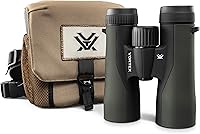
Nikon PROSTAFF P3 8x42 Review: Worth It? (October 2026)
The Nikon PROSTAFF P3 8x42 suits birders and outdoor viewers who want easy handheld scanning and room to view with glasses. Choose it for moving wildlife; consider the 10x42 for distant subjects or the Celestron and Vortex alternatives for supported viewing.
On this page (10 sections)
- Nikon PROSTAFF P3 8x42 review: who should buy it?
- What helps you find birds and follow movement?
- What do the coatings and weather protection add?
- How do the four options compare?
- Is the P3 8x42 or 10x42 better for your outings?
- How well does the P3 fit glasses wearers?
- How should you set up and focus the P3?
- How should you carry and care for the P3?
- Which buying mistakes should you avoid?
- Should you buy the Nikon PROSTAFF P3 8x42?
The Nikon PROSTAFF P3 8x42 is a good choice for birders and outdoor viewers who want an easy handheld view and room to keep their glasses on. Buy it for finding and following wildlife rather than getting the largest possible image of a distant subject.
Its strongest buying case is comfort during everyday viewing. The main compromise is carrying a full-size binocular when a smaller pair might fit your walks or travel bag better.
Nikon PROSTAFF P3 8x42 review: who should buy it?
Choose the P3 8x42 for woodland birds, feeders and mixed outdoor use, especially if you wear glasses. Skip it if you need pocket-sized binoculars or spend most of your time studying distant wildlife across open ground.
Nikon PROSTAFF P3 8x42: Best for birders with glasses

- 8x magnification
- 42 mm objective lenses
- 377 ft field of view at 1,000 yd
- 20.2 mm eye relief
- Waterproof and fogproof
A full-size choice for handheld birding and wildlife watching, with long eye relief for glasses. Choose it when finding moving subjects and viewing comfort matter more than extra magnification.
Pros
- Long eye relief for viewing with glasses
- Rubber armor for a secure grip
- Waterproof and fogproof construction
- Center focus wheel and turn-and-slide eyecups
Cons
- Full-size body needs space in a day bag
- Less magnification than the matching 10x model
Where the Nikon PROSTAFF P3 8x42 fits best
This model makes sense as a general outdoor binocular you can use without setting up a support. Its center focus wheel lets you change viewing distance as your attention moves from a nearby tree to a bird farther away.
For a new birder, finding the subject quickly matters more than making it slightly larger. A bird that stays outside your view offers no useful detail, regardless of magnification.
The P3 also suits someone who shares binoculars with family members. Its adjustable eyecups and barrel spacing let each viewer set the viewing position, though the focus and diopter may need resetting between users.
Consider a smaller format if your binoculars will spend most of the day packed away. Full-size optics are useful only when you're willing to carry them and keep them within reach.
What helps you find birds and follow movement?
The P3's moderate magnification and broad view suit searching branches, shorelines and tree lines. At 377 ft across at 1,000 yd, its field of view gives you room around a subject rather than filling the view with a small patch of scenery.
Magnification affects how easy the image is to hold still. Compared with higher power, an 8x view generally makes hand movement less distracting and helps you stay on a moving bird.
To locate wildlife, find it with your eyes first and keep looking at that spot as you raise the binoculars. Searching through the eyepieces from the start often leaves you scanning the wrong branch.
For birds in flight, begin following the bird before lifting the binoculars. Keep your elbows relaxed and turn with the movement rather than trying to chase it with small wrist motions.
These habits matter as much as choosing between closely matched fields of view. Our guide to choosing binoculars for bird watching explains how to match the format to your usual habitat.
What do the coatings and weather protection add?
The P3 has coated optics and sealed construction for outdoor viewing in changing conditions. Its multilayer-coated lenses reduce reflections, while a silver-alloy coating on the prism's mirror surfaces helps reflect light toward your eyes.
Those features support brightness and contrast, but they don't turn fading daylight into daylight viewing. Shade, cloud cover, subject contrast and how steadily you hold the binoculars all affect the detail you can see.
The fiberglass-reinforced polycarbonate body has rubber armor for grip and external protection. Use the neck strap even when the binoculars feel secure, particularly near water or on uneven ground.
O-ring seals help keep water out, and nitrogen purging helps prevent internal fogging. Nikon specifies waterproof protection down to 3.3 ft and states that the binoculars aren't intended for underwater use.
External lens surfaces can still mist when conditions change. Let that moisture clear rather than rubbing it repeatedly, and read our guide to waterproof and fogproof binoculars if you often move between warm interiors and cold air.
How do the four options compare?
Choose the Nikon for glasses clearance and lower carrying weight, the Celestron for nearby nature and stationary use, or the Vortex for its included harness. The matching Nikon 10x42 serves a different need: making distant subjects appear larger.
| Model | Magnification | Eye relief | Weight | Main buying reason |
|---|---|---|---|---|
| Nikon PROSTAFF P3 8x42 | 8x | 20.2 mm | 1.3 lb | Handheld birding with glasses |
| Nikon PROSTAFF P3 10x42 | 10x | 15.7 mm | 1.3 lb | Distant subjects in open areas |
| Celestron Nature DX 8x42 | 8x | 17.5 mm | 1.8 lb | Nearby nature and tripod sessions |
| Vortex Crossfire HD 8x42 | 8x | 14 mm | 1.5 lb | Harness carry and supported viewing |
Nikon PROSTAFF P3 10x42: for open-country viewing
Choose the 10x42 if you often watch birds across water or wildlife across open fields. Its extra magnification is most useful when the subject stays still long enough for you to aim and focus.
Its field of view is 367 ft at 1,000 yd, only slightly narrower than the 8x version's. The larger practical differences are the shorter eye relief and the greater visibility of hand shake.
Skip it if you struggle to hold binoculars steady or mainly follow birds through nearby branches. The shared objective size and weight also mean it doesn't solve a carrying-space problem.
Celestron Nature DX 8x42: for close subjects and long looks
Choose the Nature DX if butterflies, flowers and nearby feeder birds are part of your routine. Its 6.5 ft close focus gives you a clear reason to consider it beyond general birding.
Fully multi-coated lenses and phase-coated BaK-4 prisms are part of its optical design. Those features don't establish a winner by themselves, so base your choice on viewing distance, comfort and carrying needs.
Its tripod adapter socket is useful for watching one area for longer periods, though the adapter isn't included. Skip it if reducing neck load is your main goal, because it's the heaviest option here.
Vortex Crossfire HD 8x42: for a ready carry setup
Choose the Crossfire HD if you want the included GlassPak harness and support for tripod or car window mounting. A harness can keep binoculars close to your chest and reduce swinging while you walk.
It has fully multi-coated lenses, rubber armor and waterproof, fogproof construction. Its shorter eye relief makes checking the full view with your own glasses especially useful.
Vortex backs it with a transferable lifetime VIP warranty covering damage or defects. Exclusions include loss, theft, deliberate damage and cosmetic damage that doesn't affect performance.
For more brand context, read our Vortex versus Nikon comparison and overview of Nikon binoculars.
Is the P3 8x42 or 10x42 better for your outings?
Choose the 8x42 for frequent handheld scanning and the 10x42 for slower viewing of distant subjects. Neither magnification is the right choice for every setting.
In woods, birds often appear briefly between leaves and branches. A view that's easier to steady helps you spend that short window looking at the bird instead of correcting your aim.
Across a lake or open valley, more magnification can help you study a subject you've already found. Brace your elbows against your body or a stable surface to make that larger image more useful.
Avoid choosing by distance alone. A moving bird far away may be harder to follow than a stationary bird at the same distance, so think about both habitat and behavior.
Our 8x42 versus 10x42 binoculars guide explains the choice across more viewing situations.
How well does the P3 fit glasses wearers?
The P3 8x42 is the strongest starting point here for glasses wearers because it has the longest eye relief in this group. The right fit still depends on how far your glasses hold your eyes from the eyepieces.
Eye relief is the distance at which your eye can see the full view. Too little usable room can make the outer edge disappear when you keep your glasses on.
Start with the eyecups lowered if you wear glasses. Without glasses, extend them, then adjust until the view has a clean circular edge without black crescents.
Don't press hard against the eyecups to force a full image. Change the eyecup position and barrel spacing first, using our binocular eye relief guide if the edges remain hard to see.
How should you set up and focus the P3?
Set the barrel spacing, eyecups and diopter before judging sharpness. The center wheel handles normal distance changes after the binoculars are adjusted for your eyes.
- Attach and adjust the strap before taking the binoculars outside.
- Aim at a stationary, detailed subject in good light, away from the sun.
- Move the barrels together or apart until the two views merge into one circle.
- Set the eyecups for a complete view with your usual glasses on or off.
- Follow Nikon's instructions to set the diopter for the difference between your eyes.
- Use the center wheel when switching to subjects at other distances.
Make small focus changes rather than sweeping past the sharp point. If the image never looks right, recheck the eye position and diopter before assuming you need more magnification.
A shared pair needs extra attention because each person's diopter setting can differ. Our walkthrough on how to focus binoculars explains the general adjustment process.
How should you carry and care for the P3?
Keep the binoculars secure, dry before storage and free of loose grit before wiping. Rubber armor and sealing help outdoors, but careful handling protects the exposed lenses.
Adjust the strap so the binoculars sit within easy reach without bouncing against your waist. For longer walks, consider whether a compatible harness would make you more willing to carry a full-size pair.
Use the lens caps during transport and keep the case away from loose sand or dirt. After rain, let the exterior dry before closing the binoculars inside the case.
Blow or brush loose dust away with tools intended for optics before using a lens cloth. Follow with suitable optical cleaning materials when needed, using our guide to cleaning binoculars without scratching the lenses for the full sequence.
Never point binoculars at the sun. Concentrated sunlight can cause serious eye injury.
Which buying mistakes should you avoid?
Avoid choosing by magnification or one coating term alone. The most useful binocular is the one that fits your face, your carrying habits and the subjects you watch.
- Buying more power to fix a shaky view: higher magnification makes movement more visible; improve your hold or choose a steadier format.
- Ignoring glasses fit: eye relief helps narrow the choices, but the complete view with your own frames is what matters.
- Confusing sealed optics with mist-free outer lenses: fogproof construction doesn't stop condensation on exposed glass.
- Overlooking support accessories: the Celestron needs a separate tripod adapter, and supported viewing requires a suitable setup.
- Expecting a full-size pair to carry like pocket binoculars: make room for the case and strap as well as the body.
If your outings range from travel to birding, use our binoculars guide for birding, hunting and travel to check whether another format suits you better.
Should you buy the Nikon PROSTAFF P3 8x42?
Buy the Nikon PROSTAFF P3 8x42 for handheld birding and viewing with glasses. Choose the matching 10x42 when distant, mostly stationary wildlife is your priority and you can keep the view steady.
Choose the Celestron for nearby nature and planned tripod sessions. Choose the Vortex if its included harness and mounting options match how you'll carry and use it.
Before ordering, decide where you'll watch most often and whether you'll keep your glasses on. If you're still comparing within a spending limit, see the best binoculars under 200 dollars.
Frequently asked questions
Is the Nikon PROSTAFF P3 8x42 good for birding?
Yes, the Nikon PROSTAFF P3 8x42 suits woodland birding, feeder watching and general wildlife viewing. Its magnification helps you hold a steady image while leaving room to find moving birds, and its weather protection suits outdoor use; choose more magnification if distant, stationary subjects are your main interest.
Can you use the Nikon PROSTAFF P3 8x42 with glasses?
Yes, its 20.2 mm eye relief and turn-and-slide eyecups support viewing with glasses. Start with the eyecups lowered, then adjust their position and the barrel spacing until you see one complete image; check the view with your usual glasses because frame shape and lens distance affect the fit.
Is the Nikon PROSTAFF P3 8x42 waterproof?
Yes, the Nikon PROSTAFF P3 8x42 has O-ring seals and nitrogen purging for waterproof and fogproof protection. Nikon specifies waterproof protection down to 3.3 ft, but excludes underwater use; keep the lenses protected during transport and dry the exterior before putting the binoculars away in their case.
Should you choose the Nikon P3 8x42 or 10x42?
Choose the P3 8x42 for moving birds, handheld scanning and more room to view with glasses. Choose the 10x42 for distant subjects in open areas, especially when you can brace your arms; higher magnification makes subjects appear larger, but also makes hand movement more visible.