Binoculars vs Spotting Scope: Which Do You Need? (October 2026)
For binoculars vs spotting scope, choose binoculars for scanning on the move and a scope for distant detail from a fixed spot. Buy for your usual outing, including the support and setup time a scope needs.
On this page (11 sections)
- Binoculars vs spotting scope: which should you choose?
- Does more magnification mean you can see farther?
- Which is easier to carry on a hike?
- Which works better for hunting and wildlife watching?
- Will a larger objective lens improve the view?
- Which of these 3 optics fits your outing?
- How do you set up binoculars for a clear view?
- How should you set up a spotting scope?
- What mistakes make either optic harder to use?
- How should you care for binoculars and spotting scopes?
- Binoculars vs spotting scope: what should you buy first?
Choose binoculars for searching while moving and a spotting scope for studying distant subjects from a fixed position. The binoculars vs spotting scope decision starts with your viewing routine: brief looks along a trail or longer sessions with firm support.
For most hikers and wildlife watchers buying their first optic, binoculars are the more useful starting point. Add a scope when you can name a detail you regularly miss, such as markings on a bird across a lake.


Binoculars vs spotting scope: which should you choose?
Choose binoculars if quick access matters most; choose a scope if distant detail justifies stopping and setting up. A scope works best when your outing includes a suitable viewing spot.
| Your usual situation | Better starting choice | Why |
|---|---|---|
| Walking woodland trails | Binoculars | Quick looks help you follow brief movement |
| Watching birds across open water | Spotting scope | Supported magnification helps with distant detail |
| Scanning terrain while hunting | Binoculars | Easier to search before selecting a subject |
| Spending an hour at an overlook | Spotting scope | Setup time serves a longer viewing session |
| Carrying one optic on mixed outings | Binoculars | Fewer support requirements suit changing plans |
Skip a scope if you dislike carrying support or rarely stay in one place. Skip binoculars as your only optic if your main activity is studying small details on distant, mostly stationary subjects.
Our binoculars guide for birding, hunting and travel covers other choices by activity. If handheld steadiness is your concern, compare 8x42 vs 10x42 binoculars before settling on a size.
Does more magnification mean you can see farther?
More magnification enlarges distant detail, but it also enlarges movement and the effects of poor conditions. No optic has a single useful distance that applies to every subject.
A large animal against open ground may be easy to locate long before you can identify a small feature on it. Decide whether you need to find something, recognize it or inspect a particular detail.
The Triumph provides fixed 10x magnification; both scopes offer a 20–60x range. The scope's advantage is enlarging a subject you have already found, provided the air and support allow a clear view.
Binoculars vs spotting scopes: when is extra power useful?
Extra power helps with small features on distant subjects that stay in view. It is less useful when the subject moves quickly through cover or heat shimmer makes its outline ripple.
Start a scope at its lowest setting, then increase power only while useful detail improves. If the image becomes dimmer or harder to interpret, back the zoom down rather than forcing the highest setting.
For more on distance limits, read how far you can see with 10x42 binoculars. A distance alone cannot tell you whether a bird's markings or an animal's outline will be clear.
Which is easier to carry on a hike?
Binoculars are the simpler trail companion because they can stay accessible without a separate support setup. For a scope, count the whole kit rather than just the optical body.
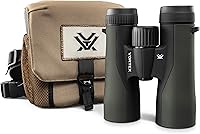
The Triumph weighs 0.45 kg and includes a neck strap and adjustable GlassPak harness. That carry arrangement suits frequent stops when you want the optic ready without repeatedly opening your pack.
The Crossfire weighs 3.3 lb, while the Talos weighs 2.4 lb. Add your tripod, head, adapters and protective gear before deciding whether either scope fits your route.
A short walk to a lake hide is different from a steep all-day hike. Carry a scope when the destination offers a worthwhile viewing session, rather than hoping you will find a use for it along the way.
Check packed length and access, too: an optic buried beneath clothing is unlikely to help with a brief sighting. Our best binoculars for hiking guide explores choices for walking trips.
Which works better for hunting and wildlife watching?
Binoculars handle the search; scopes handle close inspection from a distance. The habitat and the subject's movement determine which job takes more of your time.
In woods, birds and animals may appear briefly between branches. Binoculars are quicker to raise, and a broad view helps you keep track of where the subject went.
Across a lake, open field or valley, a stationary subject gives you time to use a scope. This is where added magnification can help separate visible markings that remain too small in binoculars.
For hunting, start with the optic you will use throughout the day, then add a scope for planned glassing stops. Our best binoculars for hunting guide covers binocular options for that role.
If you carry both, locate the subject with binoculars before moving to the scope. Note a nearby rock, tree or shoreline feature so you can find the same patch of ground through the narrower view.
Will a larger objective lens improve the view?
A larger objective can collect more light, but brightness also depends on magnification and optical design. Lens diameter alone does not tell you which optic will show the most useful detail.
The Triumph has 42 mm objectives, while both scopes have an 80 mm objective. The larger scope opening supports a different viewing task, but brings more bulk and does not cancel the demands of high magnification.
Exit pupil helps explain the tradeoff: divide objective diameter by magnification to estimate the width of the light beam leaving the eyepiece. Increasing zoom reduces that beam, so a large front lens does not guarantee a bright view at maximum power.
At dawn or dusk, try less magnification before deciding the scene is too dark. Careful focus and a steady position can also matter more than another turn of the zoom ring.
Which of these 3 optics fits your outing?
Pick by viewing style first, then compare the features that make that style easier. These products represent one mobile binocular option and 2 scopes for supported observation.
Vortex Triumph HD: frequent scans between stops
The Triumph suits a walker or hunter who wants binoculars ready throughout the outing. Adjustable rubber eyecups and a diopter let you set the view for your eyes, while waterproof and fogproof construction suits outdoor use.
It is also tripod adaptable, which gives you the option of supporting it during longer sessions. Skip it as your only tool if your main goal requires zooming into small, distant features.
Vortex Crossfire HD: longer sessions from a fixed spot
The Crossfire suits observers who want an angled scope with controls for a supported setup. Its helical focus adjusts sharpness, and the rotating mounting collar helps position the eyepiece for a comfortable view.
The Arca-Swiss compatible foot can simplify mounting with a matching clamp. Check compatibility before buying support, and skip this option if your outings leave little time for extended observation.
Athlon Talos: reducing scope body weight
The Talos suits a viewer who wants a lighter scope body than the Crossfire for planned stops. Fully multi-coated lenses, waterproof construction and nitrogen purging are its relevant outdoor features.
Its table-top tripod compatibility can fit observation from a solid bench or table. Skip that support arrangement if your viewing locations offer no suitable surface, and check the mounting requirements for your intended setup.
How do you set up binoculars for a clear view?
Set the barrel spacing, eyecups and diopter before judging sharpness. Incorrect adjustment can make suitable binoculars feel uncomfortable or leave one eye with a blurred view.
Move the barrels until you see one circular image rather than overlapping circles. Adjust the eyecups so your eyes sit at a distance that gives a full view without dark edges.
Follow the binocular instructions to balance focus between your eyes with the diopter, then use the center focus as subject distance changes. Recheck the setting if someone else has adjusted the binoculars.
Glasses wearers usually need the eyecups lowered, but the goal is a complete view rather than a particular position. Our guide to focusing binoculars explains the adjustment sequence.
How should you set up a spotting scope?
Secure the support, find the subject at low power and focus before zooming. A stable base and comfortable eyepiece position make longer viewing sessions easier.
- Place the tripod on firm ground, with its legs spread securely.
- Attach the scope using compatible hardware and check that the mount holds it firmly.
- Set the eyepiece height so you can look through it without leaning on the scope.
- Find the subject at the lowest magnification and center it.
- Increase power gradually and refocus after each change.
Keep the center column low where practical, since extending it can reduce stability. Once the subject is centered, take your hands off the optic briefly and let vibrations settle.
On the Crossfire, loosen the mounting collar screw to rotate the body, then secure it at the chosen angle. Extend its sunshade when stray light interferes or to help shield the objective from precipitation.
For shared viewing, leave enough space for the next person to reach the eyepiece without bumping the tripod. Never point either type of optic at the sun, which can cause severe eye injury.
What mistakes make either optic harder to use?
Avoid choosing by maximum power alone and assuming all blur comes from the glass. Setup, air conditions and eye position can each limit what you see.
A common scope mistake is starting fully zoomed in. The narrow view makes locating a subject harder, and a slight bump can move it out of sight.
Another mistake is judging distant detail through a closed vehicle window. Glass, reflections and the viewing angle can degrade the image; observe through a clear opening when you can do so safely.
Heat rising from sunlit ground can also blur a supported view. Reduce magnification or change your viewing position rather than repeatedly chasing focus through moving air.
Finally, avoid pressing your face hard against the eyepiece. Adjust your position and eyecup instead, since contact can transmit movement to the optic.
How should you care for binoculars and spotting scopes?
Protect the lenses from grit and store the optic dry. Waterproof construction does not remove the need to clean and dry the exterior after wet or dusty outings.
Use caps during transport and keep loose gear from rubbing against exposed glass. Before wiping a lens, remove loose particles with a suitable blower or soft lens brush.
Use lens-safe cleaning supplies for remaining marks, following the optic's care instructions. A shirt sleeve can drag grit across the coating, so carry a clean lens cloth in a protected pouch.
Let damp cases and straps dry before packing everything away. Our binocular lens-cleaning guide explains how to remove dirt without grinding it into the glass.
Binoculars vs spotting scope: what should you buy first?
Buy binoculars first for varied outings, especially if you are still learning where and how you enjoy watching wildlife. Buy a scope first when your regular activity already involves a fixed viewing position and distant subjects.
Choose the Triumph for a routine built around walking and frequent scans. Choose the Crossfire when its mounting and viewing controls fit your stationary setup, or consider the Talos when reducing scope body weight matters more.
Before adding a second optic, identify the job your first one cannot do. If binoculars cover your normal viewing, keep the kit simple; if distant details repeatedly stop you, plan a scope and support together.
For the binocular route, use our guide to choosing binoculars to narrow the size and fit before you buy.
Frequently asked questions
Are binoculars or a spotting scope better for hunting?
Binoculars are the better first choice for active hunting because they stay ready for repeated scans and help you follow movement. Add a spotting scope when you regularly stop to inspect distant terrain or animal details, and have room for stable support as well as the optic.
Can you use a spotting scope without a tripod?
A spotting scope needs firm support for useful high-power viewing, though that support does not always have to be a full-height tripod; a compatible table-top tripod on a solid surface can work. Handholding makes movement harder to control, so begin at low power and keep the subject centered.
Do binoculars see farther than a spotting scope?
Neither has a fixed maximum viewing distance, but a higher-power spotting scope can reveal smaller distant details when conditions allow; binoculars help you locate subjects quickly. Distinguishing a large animal from its surroundings takes less detail than identifying a small marking, so the task matters as much as distance.
Can binoculars and a spotting scope use the same tripod?
They can share a tripod if its capacity, head and mounting hardware suit both optics; the Triumph is tripod adaptable, while the Crossfire has an Arca-Swiss compatible foot. Check the required binocular adapter and clamp fit before buying, and allow for the weight of the entire mounted setup.
Should I bring both binoculars and a spotting scope?
Bring both when your trip includes searching while moving and longer stops to inspect distant subjects; binoculars handle the search, and the scope handles closer study. For short walks or routes without suitable viewing stops, leave the scope behind unless you have a clear use for it.