6 Best Binoculars for Safari (October 2026)
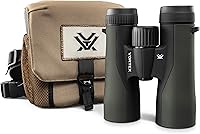
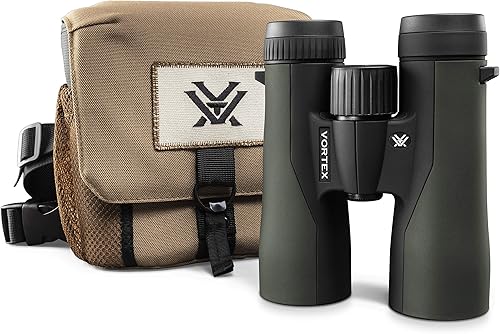
The best binoculars for safari include the Vortex Triumph HD 10x42 for first safari trips, the Vortex Crossfire HD 12x50 for distant stationary wildlife, and the Vortex Crossfire HD 10x42 for mixed safari days.
On this page (10 sections)
- How we chose the best binoculars for safari
- Which safari binoculars suit your trip?
- Is 10x or 12x better for safari?
- What field of view helps you find safari wildlife?
- How much binocular weight should you carry on safari?
- Which safari binoculars work best with glasses?
- How should you set up binoculars before a game drive?
- Do waterproof binoculars still need care on safari?
- Which mistakes make safari binoculars harder to use?
- Final decision: the best binoculars for your safari
The Vortex Triumph HD 10x42 is our top pick among the best binoculars for safari because it pairs useful viewing adjustments with weather protection and an included carry harness. Choose the Nikon PROSTAFF P3 if finding animals quickly across a wide scene matters most.
Your viewing habits should settle the choice. A pair that stays steady and ready around your chest will usually serve you better than extra magnification that feels shaky or stays packed away.
For a wider travel comparison, see our binoculars guide for birding, hunting and travel. Our Alaska cruise binocular picks also cover viewing from vehicles and exposed travel settings.
Our picks at a glance
-
1

-
2

-
3
How we chose the best binoculars for safari
We prioritized usable reach, carrying comfort and easy subject finding, then included higher-magnification options for supported viewing. Weather protection, eye relief and included carrying gear also shaped the recommendations.
The scores reflect each model's features and fit for safari travel. Choose by the tradeoff that matters on your trip, since a lower-ranked pair can better suit glasses, frequent scanning or a fixed viewing position.
A walking safari puts more weight on comfort and access. Long stops overlooking open ground make support and magnification more useful, while bird sightings reward a view that is easy to search.
| Product | Best for | Magnification | Objective lenses | Eye relief | Our score |
|---|---|---|---|---|---|
| Vortex Triumph HD 10x42 | first safari trips | 10x | 42 mm | 17 mm | 9.0 |
| Vortex Crossfire HD 12x50 | distant stationary wildlife | 12x | 50 mm | 15 mm | 8.7 |
| Vortex Crossfire HD 10x42 | mixed safari days | 10x | 42 mm | 15 mm | 8.7 |
| Vortex Diamondback HD 12x50 | supported wildlife watching | 12x | 50 mm | 14 mm | 8.4 |
| Nikon PROSTAFF P3 10x42 | finding moving animals | 10x | 42 mm | 15.7 mm | 8.2 |
| Nikon PROSTAFF P7 10x42 | frequent safari travelers | 10x | 42 mm | 15.7 mm | 7.9 |
Which safari binoculars suit your trip?
Choose the Triumph for a ready-to-carry first pair, the Nikon models for broad scanning, or either 12x option for supported distance viewing. The Crossfire HD 10x42 sits between those uses with a supplied harness and a more forgiving view than the larger Crossfire.
1. Vortex Triumph HD 10x42: best binoculars for a first safari
Vortex Triumph HD 10x42: Best for first safari trips
- Fully multi-coated lenses
- Waterproof and fogproof
- Adjustable eyecups and diopter
- GlassPak harness included
A practical first safari pair with an included harness and adjustable viewing settings. Choose it when carrying convenience and weather protection lead your checklist.
Pros
- Harness and neck strap included
- Longest eye relief among these picks
- Tripod adaptable
Cons
- Full-size body needs room in your day bag
- Glasses fit still needs a personal check
The Triumph suits travelers buying one pair for wildlife drives, permitted walks and later outdoor trips. Its GlassPak harness and neck strap give you carrying options without making a separate harness your first decision.
The polycarbonate chassis has rubber armor for grip, and nitrogen purging supports its waterproof and fogproof construction. Fully multi-coated lenses and an HD optical system complete the viewing package.
Adjustable eyecups and a diopter let you set the view for your eyes. Its 17 mm eye relief is the longest here, making it a useful starting point for glasses wearers, though the full view still depends on your frames.
Choose it if you want practical carrying gear and viewing adjustments in one package. Skip it if your main requirement is the broad scanning view described for the Nikon models, or if a full-size pair feels bulky against your chest.
Read our Vortex Triumph HD 10x42 review for a closer look before choosing your everyday travel pair.
2. Vortex Crossfire HD 12x50
Vortex Crossfire HD 12x50: Best for distant stationary wildlife
- 12x magnification
- Fully multi-coated lenses
- Waterproof and fogproof
- Tripod and car-window-mount adaptable
Choose this pair for distant animals when you can stop and support your elbows or use a suitable mount. Its narrower view makes it less convenient for quickly finding nearby wildlife.
Pros
- Extra magnification for distant subjects
- GlassPak harness included
- Works with a tripod or car window mount
Cons
- Narrower view than the Crossfire HD 10x42 and Nikon picks
- Heavier than the smaller Crossfire and Nikon models
The Crossfire HD 12x50 suits travelers who expect long looks at distant, fairly still animals. Think of watching a herd from an overlook rather than finding a bird that keeps moving through nearby branches.
Its 12x magnification enlarges distant subjects, but also enlarges movement from your hands. Tripod and car-window-mount adaptability give you support options, provided the mount suits your vehicle and your guide permits its use.
The field of view is 273 ft, so locating an animal can take more care than with the wider choices here. Keep your eyes on the subject as you lift the binoculars, rather than looking down and then searching again.
Choose this model when distance matters and you can settle into a stable position. Skip it for a first pair if you struggle to hold binoculars steady or expect most sightings to be brief.
Our Crossfire HD vs Diamondback HD comparison explains the differences between the two Vortex ranges.
3. Vortex Crossfire HD 10x42
Vortex Crossfire HD 10x42: Best for mixed safari days
- 10x magnification
- Fully multi-coated lenses
- GlassPak harness included
- Tripod adaptable
A useful compromise for travelers who alternate between wildlife drives and walks. It combines a wider view than the two 12x options with an included harness.
Pros
- Wider view than either 12x50 pick
- Center focus and right-side diopter
- Waterproof and fogproof
Cons
- Less field width than either Nikon
- Eye relief may feel tight with some glasses
The Crossfire HD 10x42 is a practical choice for days split between driving, scanning and walking. It provides a wider view than either 12x pick while keeping the included GlassPak harness.
Its 325 ft field of view gives you more room to locate and follow wildlife than the larger Crossfire. You still need a deliberate hold, but the lower magnification is a better match for frequent handheld use.
Center focus adjusts both barrels, while the right-side diopter compensates for differences between your eyes. Rubber armor provides grip, and waterproof, fogproof construction covers changing outdoor conditions.
Choose it if you want the Vortex carrying package without committing to the higher-power format. Skip it if maximum field width is your priority, since both Nikon options show more of the surrounding scene.
Its 15 mm eye relief also deserves care if you wear glasses, especially frames that sit far from your eyes. Our Crossfire HD 10x42 review covers the model in more detail.
4. Vortex Diamondback HD 12x50
Vortex Diamondback HD 12x50: Best for supported wildlife watching

- 12x magnification
- Dielectric prism coating
- Armortek exterior lens coating
- GlassPak harness included
A choice for patient observers who want higher magnification and protective exterior lens coatings. Prioritize a steady viewing position and check glasses fit before choosing it.
Pros
- Tripod and car-window-mount adaptable
- Argon purged and O-ring sealed
- Exterior coating protects against oil and dirt
Cons
- Shortest eye relief among these picks
- Higher magnification makes shake more visible
The Diamondback HD 12x50 suits patient viewing from a stable support, with added lens coatings that distinguish it from the Crossfire range. Choose it for that feature set rather than expecting it to solve the handling demands of higher magnification.
It has dielectric prism coating, and Vortex says the Armortek exterior coating protects lenses from scratches, oil and dirt. Argon purging and O-ring seals provide waterproof and fogproof construction.
The 271 ft field of view favors careful observation once you have found the animal. It gives little field-width reason to choose this model over the larger Crossfire, so focus on coatings and personal fit.
The main reason to skip it is its 14 mm eye relief, the shortest here. Glasses wearers who cannot see the whole field comfortably should choose another pair even if they like the other features.
It includes a GlassPak harness and accepts a tripod or car window mount. Read our Crossfire HD vs Diamondback HD guide to weigh the range differences.
5. Nikon PROSTAFF P3 10x42
Nikon PROSTAFF P3 10x42: Best for finding moving animals

- Wide field of view
- Multilayer-coated lenses
- Turn-and-slide eyecups
- Waterproof and fogproof
Choose the P3 when locating wildlife quickly matters more than having a supplied harness. Its wide view and relatively low weight suit frequent scanning.
Pros
- 367 ft field of view at 1,000 yd
- 1.3 lb weight
- Neck strap and case included
Cons
- No carrying harness included
- Lacks the P7's locking diopter and repellent lens coating
The P3 is the choice for travelers who often lose the animal while raising their binoculars. Its 367 ft field of view at 1,000 yd gives you more surrounding ground to work with than either Crossfire or the Diamondback here.
That width helps when following an animal across gaps in vegetation or shifting between members of a herd. It also makes the P3 a useful choice if safari birds interest you as much as larger wildlife.
Multilayer-coated lenses and a silver-alloy prism coating are part of its optical design. The rubber-armored, fiberglass-reinforced polycarbonate body has waterproof and fogproof protection.
Choose the P3 for scanning and straightforward travel use. Skip it if you specifically want a supplied chest harness, a locking diopter or repellent exterior lens coatings.
Its neck strap and case cover basic carrying needs, though you may prefer a harness for longer walks. If steadiness remains your main concern, our 8x42 vs 10x42 binoculars guide helps you decide whether to step down in magnification.
6. Nikon PROSTAFF P7 10x42
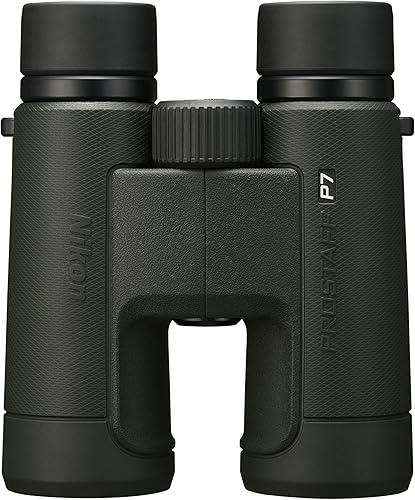
Nikon PROSTAFF P7 10x42: Best for frequent safari travelers
- Wide field of view
- Locking diopter
- Oil- and water-repellent lens coating
- Phase-correction and dielectric prism coatings
The P7 suits repeat travelers who value a locking eye adjustment and easier lens cleanup. Its field width matches the P3, so choose it for those added features.
Pros
- 367 ft field of view at 1,000 yd
- Locking diopter preserves your adjustment
- Repellent coating helps with moisture and smudges
Cons
- No field-width advantage over the P3
- Neck strap and case supplied rather than a harness
The P7 suits repeat travelers who want a fixed eye adjustment and easier lens cleanup. Those are the clearest reasons to choose it over the P3, which matches its field width.
The locking diopter helps keep your eye-specific adjustment from shifting during carry. That is useful when you want to lift the binoculars and focus without first checking whether the adjustment ring has moved.
Nikon says its oil- and water-repellent exterior lens coatings make moisture and smudges easier to remove. Phase-correction and dielectric prism coatings also distinguish its optical design from the P3.
Choose it if those features solve a recurring annoyance on outdoor trips. Skip it if you mainly want a wider view than the P3, since changing to the P7 will not provide that gain.
A repellent coating still needs careful cleaning when grit is present. Follow our guide to cleaning binoculars without scratching the lenses rather than rubbing a dusty lens with a dry cloth.
Is 10x or 12x better for safari?
Choose 10x for general handheld viewing and 12x for supported distance viewing. Extra power helps only when you can keep the subject in view and the image steady.
A vehicle that has stopped can still move as passengers shift, wind catches the body or the engine vibrates. Brace your elbows when practical, and assess the view before assuming a vehicle-mounted support will be still.
If your hands shake noticeably at 10x, consider an 8x pair instead. Less magnification can reveal more useful detail when the image stops dancing around.
Why larger lenses do not automatically give a brighter view
10x42 and 12x50 have roughly the same exit pupil, about 4.2 mm. That is the diameter of the light beam leaving each eyepiece, found by dividing objective size by magnification.
The larger objectives in the 12x format come with higher power, so they do not automatically provide a brighter image. Coatings, optical design, available light and your eyes also affect what you see.
None of these binoculars turns darkness into daylight. At dawn or dusk, prioritize a steady hold and clean lenses rather than expecting magnification alone to reveal detail in deep shade.
What field of view helps you find safari wildlife?
A wider field makes subject finding and tracking easier, especially when an animal is moving or partly hidden. It gives you more space around the subject before it slips out of view.
Compare field-width figures at the same stated distance. A width measured farther away will look larger even if the binoculars show the same angle.
Use landmarks to shorten the search: a bare branch, a pale rock or the edge of a bush. Look at that spot with your eyes first, keep your head facing it, then bring the binoculars up.
Scan slowly in overlapping sections rather than sweeping back and forth. Pause near shade, vegetation edges and other places your guide points out, then refocus when the distance changes.
How much binocular weight should you carry on safari?
Choose a weight you can keep ready for the whole outing, including your camera, water and other gear. A binocular buried in a bag is easy to miss during a short sighting.
Both Nikon models weigh 1.3 lb, the Crossfire HD 10x42 weighs 1.4 lb, and both 12x50 models weigh 1.8 lb. Those differences become more noticeable during repeated lifts or longer walks.
All 4 Vortex picks include a GlassPak harness; the Nikon models include a neck strap and case. A harness spreads the load across your shoulders and helps limit swinging, while a strap is simpler to put on quickly.
Check where the binoculars sit when you lean forward or raise a camera. Adjust the carry height so you can lift them freely without letting them knock into other equipment.
For flights with strict baggage limits, check your operator's allowance before packing. Binoculars, their case and spare carrying accessories all count toward the load.
Which safari binoculars work best with glasses?
Choose the pair that shows a full, comfortable field with your own glasses on. Eye relief is a useful starting point, but it cannot settle fit by itself.
The Nikon models provide 15.7 mm of eye relief, while the Crossfire models provide 15 mm. The Triumph offers more room and the Diamondback less, so those two deserve particular attention at either end of your shortlist.
Begin with the eyecups lowered if you wear glasses. Without glasses, start with them extended, then make small changes until dark crescents and sudden blackouts disappear.
Keep glasses on if they correct astigmatism, since the focus wheel does not replace that correction. Avoid pressing the binoculars hard against your frames to force a full view.
Our binoculars eye relief guide explains how eye position and eyecup height work together. Comfort should settle a close choice before a small difference in score does.
How should you set up binoculars before a game drive?
Set the barrel spacing, eyecups and diopter before your first outing. Doing this in calm daylight makes it easier to recognize a poor adjustment before a short wildlife sighting.
- Attach the strap or harness securely. Check each connection and adjust the carry height while wearing the clothes you expect to use.
- Set the barrel spacing. Move the hinge until both eyes see one round image without forcing your eyes inward.
- Adjust the eyecups. Find a position that gives you the full view without pressing against your face or glasses.
- Set the diopter. Following the brand's instructions, focus the left side with the center wheel, then match the right side using the right-eye adjustment.
- Check both eyes together. Look at a detailed stationary subject and confirm that normal distance changes need only the center wheel.
Record the diopter position once it suits you, and lock it if your model allows. Recheck it after lending the binoculars to someone else, since their eyes may need a different setting.
Use our guide to focusing binoculars if one side remains soft. A diopter adjustment should not become something you turn every time an animal moves.
Do waterproof binoculars still need care on safari?
Yes, weather protection helps with moisture, but lenses and moving parts still need sensible care. All 6 picks are waterproof and fogproof; none should be treated as an underwater viewing tool.
Internal fog protection does not stop condensation on exterior glass. When moving from a cool room into warm, humid air, let the binoculars adjust in their closed case before exposing the lenses.
Keep covers on during dusty transfers and store the binoculars where they will not slide around the vehicle. Rubber armor improves grip and protection, but it does not make impacts harmless.
Remove loose dust with a suitable blower or soft optical brush before using lens cleaner and a clean lens cloth. Do not grind grit into the glass with a shirt sleeve.
Let damp carrying gear dry before closing it away for storage. Our guide to waterproof and fogproof binoculars explains what those features protect against.
Which mistakes make safari binoculars harder to use?
Too much magnification, poor adjustment and slow access cause avoidable problems. Deal with those before adding accessories or changing models.
- Buying power before checking steadiness: Choose magnification around how you will hold the binoculars, not just the farthest animal you hope to see.
- Sharing one pair without resetting it: Different eye spacing and diopter needs can make each handoff slow, especially during brief sightings.
- Using them while the vehicle is bouncing: Wait for a stop rather than fighting motion and pressing eyecups against your face.
- Leaving the case packed under other gear: Keep the binoculars secure but reachable when your guide expects wildlife.
- Confusing glare with poor focus: Avoid aiming near the sun, and never look directly at it through binoculars.
- Ignoring close wildlife: Lower the binoculars when the animal is near enough to enjoy with your eyes; you gain a wider sense of its movement.
- Wiping dust straight away: Clear loose particles first, even when the lenses have a protective coating.
If you plan to use a window mount, confirm the vehicle arrangement with your operator before packing it. An open-sided safari vehicle may not provide the window edge that mount requires.
Final decision: the best binoculars for your safari
Choose the Triumph HD for a first safari when the included harness and adjustable fit meet your needs. Choose the P3 for finding wildlife across wide scenes, or the P7 when its locking diopter and repellent coatings earn their place.
The Crossfire HD 10x42 suits mixed driving and walking days with a supplied harness. Choose the Crossfire HD 12x50 for supported distance viewing, or the Diamondback HD 12x50 if its added coatings matter and its shorter eye relief fits you.
The best binoculars for safari should feel ready and comfortable before departure. Set them up, practice finding a distant subject and check that you can carry them alongside the rest of your gear.
If walking will be a large part of the trip, compare our best binoculars for hiking before committing to the heavier format.
Our top 3 picks at a glance
-
1
-
2
-
3
Frequently asked questions
Are 10x42 binoculars good for safari?
Yes, 10x42 binoculars suit general safari viewing, especially when you want detail across open ground without carrying larger objectives. They still need a steady hold, particularly during long looks.
If keeping the image still feels difficult, consider an 8x pair rather than assuming more magnification will show you more usable detail.
Should I choose 10x42 or 12x50 binoculars for safari?
Choose 10x42 for frequent scanning and mixed activities, or 12x50 for distant animals when you can support the binoculars. The larger format does not automatically give a brighter view.
Both formats have roughly the same exit pupil, while higher magnification makes hand shake more obvious and can slow subject finding.
Do safari binoculars need to be waterproof?
Waterproof and fogproof construction is worth prioritizing for rain, humid mornings and travel between different temperatures. All 6 picks here provide both features.
Internal fog protection does not prevent moisture from forming on the outside of cold lenses, so allow time for the binoculars to adjust before wiping them.
Can I use binoculars while wearing glasses?
Yes, keep your glasses on if you need them for a clear view, then adjust the eyecups until you can see the field comfortably. Start with the cups lowered and move them outward only as needed.
Eye relief helps narrow your choices, but your frame shape and lens position determine the final fit.